Photo by Salina Kolonitskaia, Pexels.com.
The seventh branch of Beanstalk of Spiritual Development is typically only experienced as temporary peak experiences, just long enough to achieve a momentary but profound glimpse of wholeness and unity with the divine. Unbounded unity is the experience that tells the pilgrim on a spiritual development path that one is, at least, peaking over the threshold of the highest stage. When one is on the seventh branch of the Beanstalk of Spiritual Development one’s indicative responses are of sacredness and one’s fall-back emotion is compassion The tell-tale sign that one has achieved the last level of spiritual development may come as a fleeting impression that there is no difference between you and God.
This level of spiritual development is where people exhibit the infinite intelligence response and see God as the God of Pure Being. On Branch Seven, faith is a matter of unity with God.
The Dilemma Of Branch Seven
Those who rest on the top branch are faced with the dilemma of being bounded by nothing. One returns to the source.
Being an eartHeart and becoming a saint are long journeys. There is no short cut, no fast way to get a halo.
The previously described Beanstalk of Spiritual Development is a good way to visualize the work that is needed to be done to add layers of depth to one’s spiritual development. It is a good guide for how to become a saint, particularly for the vast majority of people who subscribe to the religious or mythic way of thinking and speaking. It is a very good method of moving one’s development from a perspective dominated by Ego to a deeper perspective wherein Theo is more pronounced. It describes a, more or less, linear route towards the perception of the boundless eternal mystery that animates and transcends all: the Mystery variously referred to as “Spirit,” “God,” “the Absolute,” “the Anima Mundi,” “Allah,” or “Buddha Nature.”
What is needed for our purposes here is a developmental model that is about both ascent to Spirit and descent to Soul––one that, in other words, also describes, through the symbol of a rolling circle or wheel, how to grow by coming into better connection with one’s “ultimate place in the world” (Plotkin, 2008, p. 43). By “place” I not only mean geographical location (as in, “I live in the place called the Middle Mississippi Forested Hills Natural Region”) but also niche (as in “it is not my place to tell a nuclear engineer how to do his job”). “Place,” as I am using it here, has to do with role or purpose.
The Soul has to do with relationship—how a person or thing relates to others (as in, “its place in the great scheme of things”). The Soul has to do with uniqueness—its distinct but not separate place in the web of life.
While nothing said at this waypoint guarantees that if you do some specific practice you will end up on a particular branch of spiritual development, for me, just knowing how to recognize the branches and what dilemmas had to be overcome psycho-spiritually to arrive at the next higher branch helped me to move to higher stages of development. Without this knowledge, I may still be happily in my long-held, familiar state of restful awareness and peace at the Third Branch, thinking that being a concerned environmentalist is the culmination of spiritual
Photo by Nicolett Emmert, Pexels.com.
HumaNatureConnect Activity
Standing Solidly On The Seventh Branch Of Spiritual Development
For this activity, take another stab at the eight determining spiritual development questions, again with some pertinent direction. Given what you learned about the nature of the seventh stage of spiritual development, answer the following questions:
For the “Who am I?” question, describe how you are the Source.
For the “How do I fit?” question, describe how you are the realization of what you always have been, unchanged more than changed, no longer projecting versions of reality that are inadequate.
For the “What is the Nature of good and evil?” question, discuss how in your life good is the union of opposites and evil no longer exists.
For the “How do I find God? question, discuss the role of transcendence in your life.
For the “What is my life challenge?” question, describe ways that you seek to be yourself.
For the “What is my greatest strength? question, describe how unity works in your life.
For the “What is my biggest hurdle?” question, describe how duality works in your life. And
For the “What is my greatest temptation? question, describe how you live without temptation.
Photo by Phil Mitchell, Pexels.com.

Nocturnal Pilgrimage
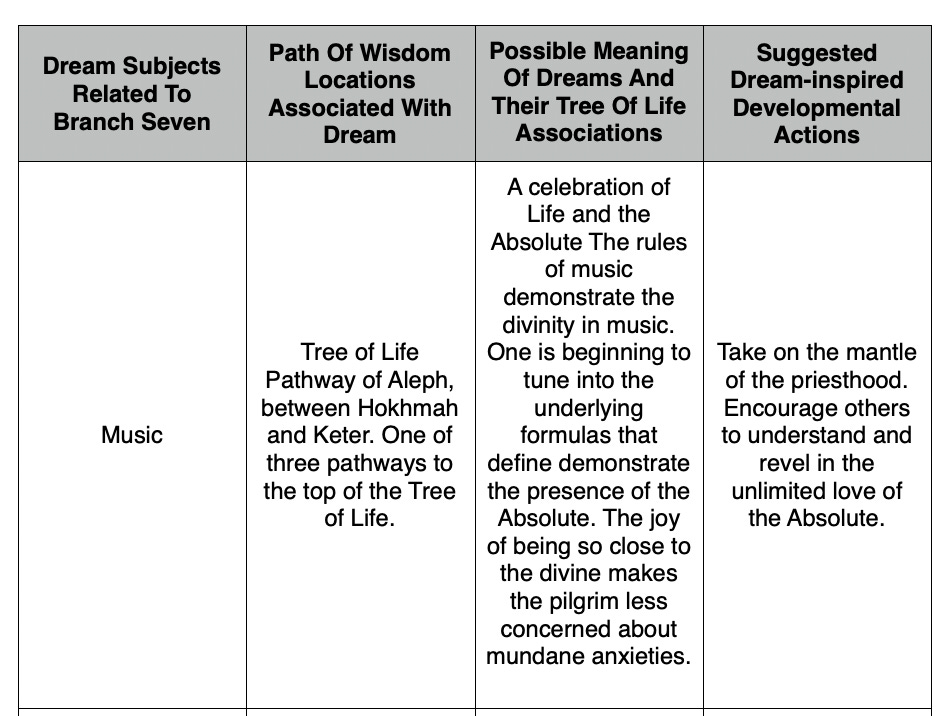
Look over the next table and consider the associations as food for thought for your own dream tending.