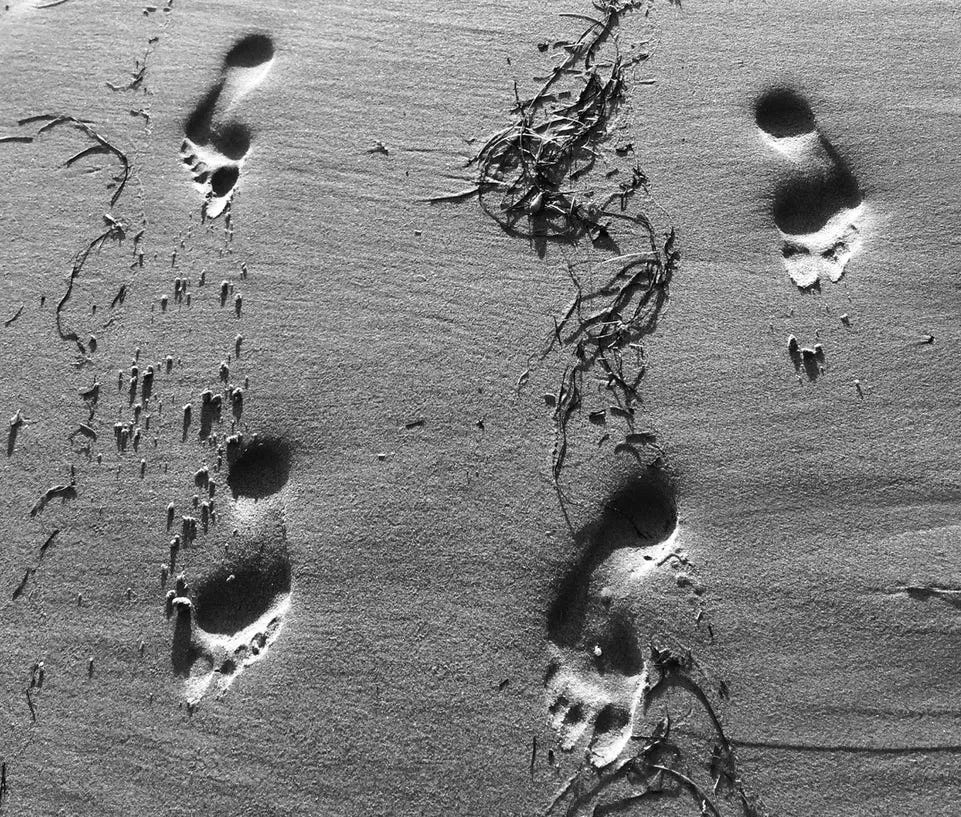
Photo by Don Pierce
As the ecological self strengthens, perception undergoes a quiet but radical shift.
You stop seeing the world as a collection of separate objects and begin sensing it as a living system — a field of relationships, rhythms, and patterns.
This is ecological perception.
Ecological perception is not about seeing more.
It is about seeing differently.
It is the shift from:
detail → pattern
objects → relationships
events → systems
meaning → movement
interpretation → sensing
When the nervous system is overwhelmed, perception becomes narrow and literal.
You see threats, signals, implications, judgments, and distortions.
You read the world through the lens of urgency.
But when steadiness becomes your baseline, perception widens.
You begin to sense the world the way the land senses itself — through rhythm, proportion, and relational change.
Ecological perception is not mystical.
It is ecological intelligence.
You begin to notice:
the way wind moves through a landscape
the way light shifts across a hillside
the way birds adjust their calls when the field changes
the way water organizes itself around obstacles
the way a forest communicates through silence and sound
These are not metaphors.
They are perceptual cues — the world revealing its structure.
As this way of seeing deepens, you begin to perceive human environments the same way:
the rhythm of a conversation
the coherence or incoherence of a room
the proportion of a decision
the timing of an action
the relational field between people
You stop reading people’s intentions and start reading the field they are part of.
You stop interpreting behavior and start sensing pattern.
You stop reacting to content and start responding to movement.
Ecological perception is the ability to sense the world as a system rather than a sequence.
It is not about being perceptive.
It is about being in relationship.
When you perceive ecologically, you no longer feel like an isolated observer.
You feel like a participant in a living field.
This is the quiet truth:
Ecological perception is not a skill.
It is a consequence of coherence.
When the self becomes ecological, perception follows.
HumaNatureConnect Activity
Reading the world through pattern rather than detail
Go to a natural place where multiple elements interact — wind in trees, water moving over stones, grasses shifting, birds calling, light changing. Sit or stand where you can observe the relationships between these elements.
Let your breath settle.
Let your attention widen.
Then ask:
What is the pattern here?
Use these prompts:
What moves together.
What moves in opposition.
What changes when one element shifts.
What rhythm emerges when I stop focusing on individual details.
What becomes clearer when I sense the whole rather than the parts.
Stay for ten minutes.
Afterward, write:
What pattern I perceived.
What relationships I noticed.
What rhythm emerged.
What felt like ecological perception.
This activity teaches you to read the world as a system rather than a set of objects.
Nocturnal Pilgrimage
Sensing the field without visual detail
Step outside after dark. Night removes detail and forces perception to widen. You cannot rely on sight, so you begin to sense the world through sound, air, rhythm, and presence.
Stand or sit in one place.
Let the darkness reorganize your perception.
Use these prompts:
What do I sense when I cannot see.
What patterns emerge through sound.
What relationships become clearer in the dark.
What part of me perceives the field rather than the objects within it.
When you return indoors, write:
What I sensed.
What I understood.
What felt like ecological perception.
Night reveals the system beneath the surface.
Conclusion
Ecological perception is the third movement of the Ecological Self Series — the moment when the world becomes readable through rhythm, pattern, and relationship rather than through detail, interpretation, or urgency.
It is the shift from seeing the world as a set of separate events to sensing it as a living field.
Nature teaches this way of seeing effortlessly.
When the self becomes ecological, perception naturally follows.
This is the work of ecological perception:
to read the world the way the land reads itself.