

Pexels.com.
The concept of the opportunities that an organism has to act in the environment is central to ecological psychology.
Direct perception: Perceiving actionable opportunities in the environment allows organisms to perceive their surroundings without cognitive mediation or internal representations. Direct perception allows immediate and effective interactions with the environment.
Reciprocity between organisms and environments: Perceiving action opportunities highlights the reciprocal relationship between organisms, their environment, and each other. These are not only properties of the organism or environment, but also exist when they interact. This emphasizes that perception and actions are context-dependent.
Guidance for Behavior: Perceiving action opportunities allows organisms to identify and use resources, navigate obstacles and engage in behaviors essential for survival and wellbeing. A tree branch, for example, may provide an opportunity for action for a child who is adventurous, but not an adult. This illustrates how actions are dependent on the abilities of each individual.
Learning and Development: Engaging with opportunities for action promotes skill acquisition and perceptual development. As people interact with their environments, they improve their ability to detect opportunities for action and respond, leading to adaptive behaviors.
Evolutionary adaptation: Opportunities to act play an important role in evolution by influencing how organisms adapt their environment. Organisms which perceive and respond to opportunities for action will be more likely survive and reproduce. This influences the development of species specific perceptual abilities and motor abilities.
In ecological psychology, it is important to understand the opportunities for action because this provides a framework that integrates perception and action. This perspective shifts away from viewing perception simply as a passive receipt of sensory information, and instead emphasizes an active engagement with the environmental. Perception is intrinsically tied to the opportunities for action offered by the environment.

Pexels.com
HumaNatureConnect Activity
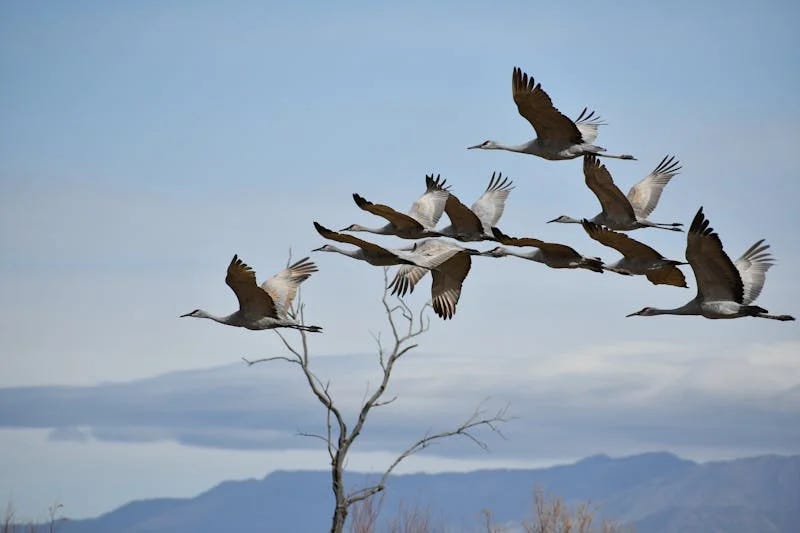
Here we will begin our more in-depth look at opportunities for action offered to organisms in nature. We will begin with bird migrations.
