In making your determinations, listen mainly to the words from within and remember that words from without are likely to encourage you to conform rather than to contribute.
After focusing, one then creates smaller versions of the prospect one is seeking—building prototypes, where refinements can occur on a scale that is manageable.
The world dreams too.
To foster greater imagination and creativity, commune with nature* and consider some activities that make you feel inspired, from this list determine who in the world is making a living doing such things, plan how you will model their behavior, and add your own individuality to the work.
Remember that you become what you think about. For this reason, be wary of thoughts of doubt. Eliminate conditioned beliefs regarding the impossibility of planned actions. If you can conceive it, you can create it. Allow yourself to wander freely in your imagination. Exclude nothing in your fantasies. Imaginative meanderings form the unlimited river of life.
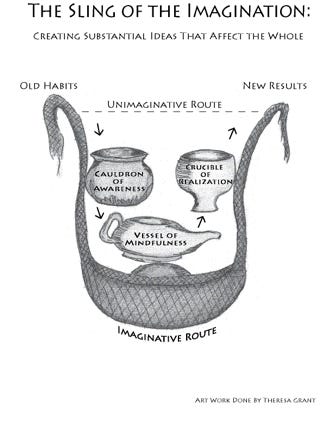
To facilitate these worthwhile meanderings, start thinking about how you would answer the following question: “What doubts or negative conditioned beliefs am I now eliminating?” You may want to focus here on outmoded patterns of thinking regarding so-called universal principles and unwanted notions of integrity generally (rather than just focusing on unwanted aspects of your own individual self). You will have a chance to let go of unworkable aspects of your individual self at the end of the next course. Here, before enrolling in the Heartwood Path: Egos course, where you will identify and secure your own unique personality, come to understand and know how to use the Sling of the Imagination, pictured below.
Imagination
What Is The Sling
I shall present the ancient sling as a metaphorical model used to illustrate what it takes for you to affect the whole—the whole household, the whole neighborhood, the whole nation, or the whole environment. Yes, like diminutive David slaying the giant Goliath, little ‘ole you can change the big ‘ole world. But first you will need to do some work and grow.
There will be many new words, some lofty principles, and some metaphors in this explanation of the Sling of the Imagination. Use these literary devices to help you work your way through this section. Read it carefully, perhaps more than once, and you will come to understand a useful method for making big changes in the world. If you need more help, there are carefully trained guides available who can help you with this or any other part of this series of courses.
The Sling of the Imagination is one of the most important tools for you to use to find happiness, protect the beauty of nature, secure environmental sustainability, or make any positive change in society, culture, or the world.
We will be using as a metaphor the sling David used in the Bible. Slings are ancient weapons made of many different materials, but all consist of two lengths of cord, fabric, or hide attached to a pouch.
Like David who used a sling to slay Goliath, you too are, metaphorically speaking, armed with a sling—albeit of a different sort. The sling I am talking about is not used to pitch a stone to hurt an individual. It is instead a virtual, metaphorical, symbolic one used to cast forth ideas that shift the whole for the better.
Remembering David’s words that “The Lord saveth not with sword and spear,” and John Lennon’s lyrics “War is over, if you want it” the stone in the pouch of our virtual sling is replaced metaphorically with personal choice. Like a stone, choice can be used for good or for evil. To make sure your use of the sling is positive and productive, guard against picking solutions based on incomplete information, little or no self-awareness and growth, and no processes of mindfulness and realization, both explained below.
Superficial awareness (which comes from little or no use of the Imaginative Route on the Sling of the Imagination) leads to superficial reactions. We cannot truly affect the whole unless we claim our wholeness (through a deep “swoosh,” so to speak, down and around the arc that represents the Imaginative Route). I call progressing from the upper left end of the Sling directly to the upper Right Sling—without “swooshing” through the whole sling—the “Unimaginative Route.”
Why Use The Sling
I have personal experience going down the Unimaginative Route. My experience mentioned here has to do with the environmental movement. Despite this limited example, the Sling can be applied to any attempt to affect a change.
Not knowing a better alternative, the Unimaginative Route, which in its extreme form is but muddling through, was my blind, unintentional course during my days of lobbying and environmental organizing (full-time between 1975 and 1997). Fellow conservationists and myself used this so-called “unimaginative route” to, for example, stop the Meramec Dam nears St. Louis, Missouri, to preserve over 100,000 acres of Forest Service lands by including them in the Wilderness Preservation System (in Missouri and Illinois), to cut the funding for a nuclear power plant in central Missouri, and to lobby for what is (or was) the environmental safety net which includes the Clean Air Act, the Water Pollution Control Act, and the Endangered Species Act. Had we known to take the Imaginative route, even greater victories would have occurred; or, at least, they would have been achieved more efficiently and my cohorts would have learned more about themselves and advocacy in the process. Without the Sling, we muddled our way to accomplishment, too naive to know that there was another way that would have been faster and more far-reaching.
I was one of a couple dozen people who used the unimaginative route while lobbying daily in the weeks before the enactment of the second most significant conservation bill in the history of the United States (after the establishment of the National Park System)—the law that preserved over 80 millions acres in Alaska. I was assigned to lobby Midwest members of Congress. From these successes I can attest that the so-called Unimaginative route can be used to achieve important public policy victories. It’s just not the best way because it burns up too many activists and creates less than ideal results—in this instance, not enough inner world support amongst the public that could be used to maintain the vast conservation victories in the face of perennial attempts to seize the protected resources.
I call the better approach, the one that involves deep “swooshing,” the “Imaginative Route” because it affords important additions that the Unimaginative Route does not, including: 1) the Imaginative Route helps to improve the spiritual maturity of the environmentalists in the fashion outlined in this series of courses and so it affects positively not just the final outcomes but also the people making the outcomes happen and 2) it provides a way for more significant and enduring positive change. The symbolic “swoosh”––that is, following the Imaginative Route––represents what occurs from the sequence of thinking-to-experiencing-to-doing. With this three step approach, the so-called “swoosh” is personal cultivation, a systematic process of maturation.
The kinds of actions undertaken during the so-called “unimaginative route”— lobbying, grassroots organizing, holding symposia, soliciting media attention—also occur at the end of the Imaginative Route—before the Establishment stage and after the various individual development stages such as letting go, mindfulness, and letting come. In this way, the Imaginative Route, after bolstering the advocates themselves, includes everything that would happen if one was to choose only the more typical “Unimaginative Route.”
I believe that had activists in the environmental, civil rights, and other progressive movements used the Imaginative Route over the last forty years, many of the policy changes adopted during the Seventies and Eighties but which are now abandoned, underfunded, or ignored could have been sustained—resulting in a much better world. The predominant use of the Unimaginative Route meant that the activists in the various progressive movements were unable to counter the setbacks in public policy that occurred during the last decade of the Twentieth Century and the first decade of the Twenty-first Century, including the weakening of the Environmental Protection Agency, the election of congressmen less willing to support the preservation of more wilderness areas, and the lack of adequate laws to ensure that all lives—including blacks, females, school children, the disabled, and the elderly—matter.
To secure a magnificent future the Imaginative Route needs to be employed at all levels of organization—from amongst those who work at the United Nations to those who decide how to best think and behave in households and neighborhoods. The Imaginative Route of the Heartwood Path ought not to be used only by professional activists. It needs to also be employed in each household so that nearby improvements can be made and so that individual voters will have the inner world intentions and ethics and the outer world individual and group behaviors and physical systems needed to not only vote for the best candidates but also to monitor and, if necessary, alter government programs.
For the sake of the Earth and all its sentient beings, read on and pass the good news on to others. Much of this good news lies in the revelation that there is an Imaginative Route that encourages people to work on themselves before or while attempting to change the whole. The value of this important precursor to the establishment of better ideas lies in the following statement:
One cannot force others to change, but one can change oneself.
A better future awaits as more people undergo the kind of self improvement prescribed here and, thereby, become eartHearts.
Continue reading this post for free, courtesy of Don Pierce.