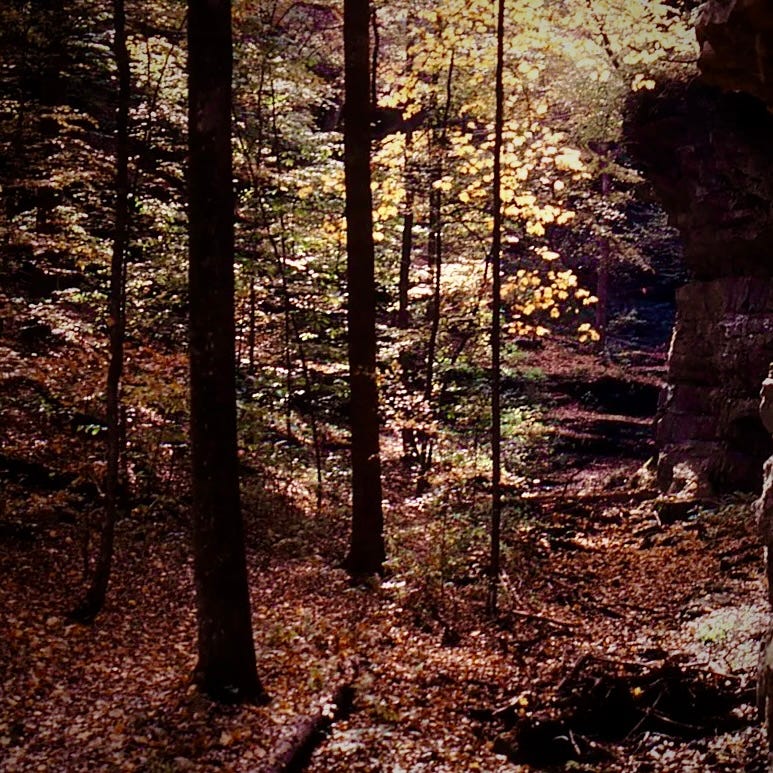
Photo by Don Pierce
The horizon of the self expands in four movements:
Me Only — the narrow band of personal survival.
Me and My People — the widening circle of kin and companions.
All People — the recognition of shared human conditions.
All Sentient Beings — the full ecological horizon, where identity dissolves into interdependence.
This expansion is not conceptual.
It is perceptual.
It arises through:
attending to ecological conditions
perceiving relations rather than objects
widening the senses
loosening the grip of names
letting go of rigid identity
entering connection experiences
dreaming oneself awake
dissolving the boundary between self and other
recognizing that ethics must be survivable
evoking the authentic whole
The horizon expands when the self stops being the center and becomes a participant in a larger field.
This is the Codex teaching.
HumaNatureConnect Activity — Expanding the Horizon Through Contact
Horizon Contact Walk
This activity widens the participant’s horizon by shifting perception from “me only” to “me in relation.” It uses natural attractions, sensory widening, and relational perception to open the ecological field.
Steps:
Enter a natural area slowly, pausing at the threshold to ask:
“What can you help me understand today?”Gain permission from the place by noticing one attraction that feels welcoming — a stone, a breeze, a tree, a patch of light.
Open and close your eyes three times to reset perception and allow new attractions to appear.
Approach one attraction without naming it. Call it a connection experience.
Use multiple senses — touch, smell, temperature, sound, motion — to widen your perceptual horizon.
Imagine becoming the attraction, adopting its perspective. Ask:
“From your way of being, what do I need to see?”Return to yourself, carrying the insight gently.
Thank the connection experience for participating in your horizon expansion.
Write down the insight and share it with someone, widening the horizon again through relationship.
This activity shifts the participant from a narrow self‑centered horizon to a relational ecological horizon — the first step toward “all sentient beings.”
Nocturnal Pilgrimage — Expanding the Horizon Through Dream
Nocturnal Pilgrimage: The Night Horizon
The nocturnal pilgrimage expands the horizon inward, using lucid dreaming and night‑mind perception to dissolve the boundary between self and other. Night is where the horizon becomes porous.
Steps:
Before sleep, set a simple intention:
“Tonight, show me what I cannot see in daylight.”As you drift toward sleep, notice any unusual shifts — changing words, shifting clocks, slow descents — signs of lucid entry.
When lucidity arrives, extend the dream by giving it a longer storyline.
This stabilizes the horizon.Inspect a dream image — spin it, touch it, walk around it — to deepen presence.
When something unusual appears, say:
“How odd is that.”
This opens the horizon further.If you wake, re‑enter the dream by lying still and recalling the last scene.
Use the dream to rehearse interactions, explore fears, or dissolve rigid identity.
Ask the dream directly:
“What lies beyond the boundary of me?”Upon waking, write down the insight immediately.
Carry the nocturnal message into daylight activity, completing the horizon arc.
The nocturnal pilgrimage shifts the participant from “me and my people” to “all sentient beings,” including those encountered in dream, symbol, and night‑mind.