Photo by Douglas Rising, Pexels.com.
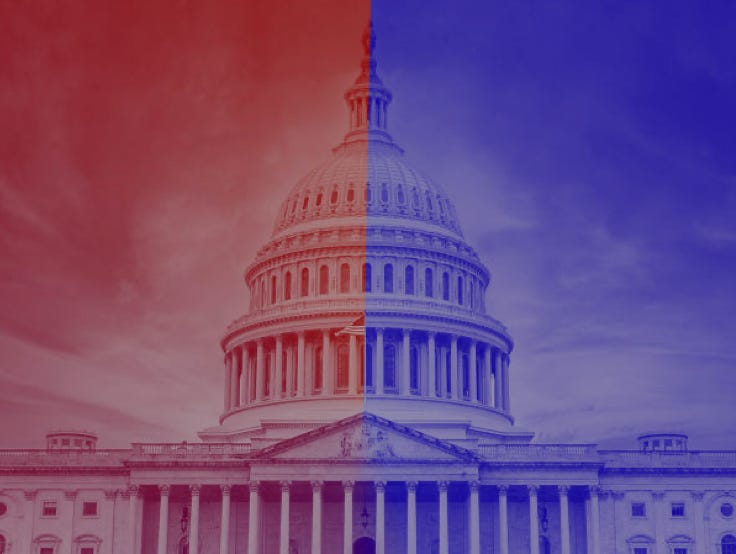
When comparing partisanship to non-partisanship we find that:
for decision making, partisan actors are driven by party platforms and loyalty and non-partisan actors are driven by issues, evidence and cooperation;
for outcomes, partisanship results in gridlock and strong ideological laws and non-partisanship results in consensus and pragmatic solutions';
for accountability, partisanship features clear responsibility via party lines and non-partisanship features responsibility that is so diffused it is hard to assign blame and credit';
for public perception, partisanship energizes supporters and alienates opponents and non-partisanship is more collaborative and often seems vague.
Today’s highly partisan Congress has left many issues under-addressed. These include childcare and early childhood support, caregiver support, aging-population services, mental health and addiction infrastructure, housing affordability and homelessness, educational inequalities, accessibility, and inclusion for people with disabilities, environmental justice and climate impacts on vulnerable communities, voting rights and electoral access, and support for working families.
To solve these deficiencies, there is a need for more congressmen who have:
intellectual develop and a middle to high level of emotional and spiritual growth;
significant life experiences and career diversity;
the ability to collaborate; and
a willingness to focus on constituent outreach and set-up listening sessions.
HumaNatureConnect Activity
Outdoor Activity: The Listening Circle of Nature
Purpose:
To illustrate through direct experience how qualities needed in Congress (intellectual and emotional growth, diversity, collaboration, and listening) are reflected and tested in natural systems.Instructions
Intellectual & Emotional Growth (Awareness Walk)
Begin with a slow, mindful walk through a natural setting (forest, meadow, park).
Every 5 minutes, pause and write down one question nature is asking you. For example:
Why do some plants thrive in shade while others demand sunlight?
How does resilience show up in a cracked rock with moss?
👉 Truth test: Growth requires curiosity and reflection; nature challenges us to ask deeper questions and stretch beyond surface observation.
Life Experience & Diversity (The Web of Many Roles)
Each participant chooses a natural being to “become” for 10 minutes (tree, insect, bird, rock, stream).
Actively imagine and journal its role, challenges, and contributions to the ecosystem.
Then, share with others what life feels like from that perspective.
👉 Truth test: Diversity of roles strengthens ecosystems—and societies.
Collaboration (The Cooperative Task)
As a group, find a fallen log, patch of weeds, or stone-filled space.
Work together silently to carefully arrange it into a small habitat (e.g., shelter for insects, clearing a path for new shoots).
Reflect afterward: How did unspoken collaboration happen? What was easy? What was difficult?
👉 Truth test: Cooperation in ecosystems mirrors human teamwork—mutual effort produces shared benefit.
Constituent Outreach & Listening (Nature’s Council)
Form a circle outdoors. Each person shares one voice from nature they noticed that deserves to be heard (the wind in the trees, the buzzing bee, the quiet stream).
Then, sit quietly for 5 minutes and simply listen to the soundscape without interruption.
👉 Truth test: Listening deeply reveals overlooked voices; in politics and ecosystems, silence teaches as much as speech.
Closing Reflection
At the end, have each person write a “Candidate Profile from Nature”:
What quality did nature reveal to me about leadership?
How can empathy, resilience, awareness, or commitment be cultivated the way ecosystems cultivate balance?
Few would disagree with the goal to have democratic elections of people with the wherewithal to see and establish policies that are good for all beings, human and otherwise. We simply cannot afford to have people with shallow perspectives making the decisions. Let’s have fair elections, but let us also keep babies and others with undeveloped personalities off of the ballot. In an upcoming post, we will present a conceptual profile of how U.S. House and Senate members might display inner nature development in terms of common dimensions of ecological psychology and personal growth (such as empathy, resilience, awareness, and commitment).
Essential Readings:
• […]
• […]

Recommended Readings:
• […]
• […]
• […]
• […]

For additional readings, visit Heartwood Path Beat.