
Hermeticism, also called Hermetism, is a religious, philosophical, and esoteric tradition based of the writings of Hermes Trismegistus. Meaning “Thrice Great,” Trismegistus is variously said to be a syncretism (amalgramation) of various schools of thought, the son of the Greek god Hermes, the son of the Egyptian god Thoth, a man who lived at the time of Moses, and, in the Third Century A.D, the author of the seven Hermetic Principles. Considered the source of the “greatest natural laws,” the Hermetic Principles are said to govern our material and spiritual life. While their exact origin is unclear, the Hermetic Principles have stood the test of time and are thought to have had a significant influence over the development of the tenets of all of the worlds major religions. Knowing these principles will give you profound insights into the deeper spiritual nature of reality. Avoid being a victim of your own ignorance by memorizing the seven Hermetic Principles. Here, now, are the most significant influences over the Greater Self:
Universal Principle # 1:
“All is mind.”
By including this first Hermetic Principle I am not saying that everything is just a figment of one’s imagination. Matter exists. But the importance of the imagination cannot be discounted. As Henry David Thoreau says,
“The world
is but a canvas
of our imagination.”
All matter has some level of consciousness and that the mind evokes order out of physical creation. Says Wallace Stevens: “Reality is not what it is. It consists of the many realities which it can be made into” (Sewall, 1999, p. 22).
The consciousness of ideas is the basic element of reality. As you will discover as you continue down the Heartwood Path, too much of what has to be understood to grow, evolve, energize, and help others as an eartHeart
cannot be explained through materialism or idealism. Throughout the Heartwood Path a third tradition, that of panpsychism, will be employed.
Panpsychism—a theory that all nature has a psychic aspect—balances the problems left by materialism and idealism. Materialism, in part, means that physical matter is the only reality. But bodies without minds are too brutish. Idealism is a theory that regards reality as essentially spiritual or an embodiment of the mind. But minds without bodies are too ethereal. Panpsychism transcends this duality through the integration of mind and body. Such integration is a better way to understand the nature of all nature—a word used over and over again along the Heartwood Path and, therefore, ought to be carefully define. Nature, when it is spelled with the first letter in lower case, means essential character, prompting force, things exclusive of mental, opposite of state of grace; the unregenerate soul; a state preceding the foundation of organized society; a thing that is not made, perfected or ordered by humans; natural scenery; and the aspect found out-of doors. When I begin the spelling of “Nature” in upper case I am referring to Nature as a singular sentient being, which is scientifically debatable, but consistent with the felt experiences and perspectives of many people. The nature of any aspect of the world is manipulated by the way we look at the world, by what we see.
Here we shall explore a basic premise of this book, that we create a future by the way we think and that we evoke the material world through the way we think. If one wants to protect the environment or improve oneself, it is one’s thinking that will begin to do the job.
“We are a landscape of all we have seen” writes Laura Sewall.
“In an immediate and active sense, we are integrators, mixing and matching the complexity of each past moment with new incoming signals. In do doing, by focusing our attention on this moment or the next, on this flower or that item, we are creators of self and world. In other words, we choose––and thus we become” (1999, p. 266).
The consciousness of ideas is the basic element of reality. Instead of positing that everything, including consciousness, is made of matter; everything, including matter, exists in and is manipulated from consciousness. Matter is real, but secondary to consciousness. It is, therefore, very important to recognize what enters into your awareness. It is not what you look at that matters. One can look at a lot of things without ever paying any significant attention to them. It is rather what you see that counts.
According to a fundamental tenet of quantum theory, the nature of reality—and probably “being-ness” itself—can be described as having the dual qualities of a particle (like individual billiard balls on a table) and a wave like (undulations on the surface of the sea). The greater hidden aspect behind all reality is not that matter is either a wave or a particle. To be is to be both. Observers evoke what is already there by the way their consciousness directs them to perceive it (although I’d like to, I can’t turn wave packets of macaroni and cheese into snow cones, for example).
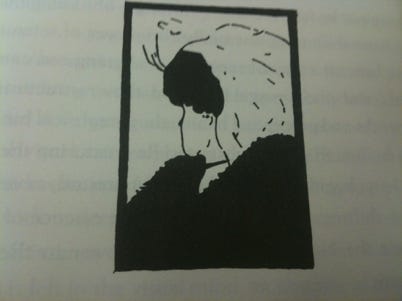
You may have seen the popular line drawing, shown above, of a woman who, depending on how you choose to view her, looks either like an ugly old woman or a beautiful young woman. Just as light has dual aspects (waves and particles) that collapse upon observation and choice, these pictures have simultaneous dual aspects that are revealed only after observation and choice. The process of evoking manifestation is something like this.
EartHearts seek to evoke a better picture, in part, by putting more attention into what and how they see, by truly seeing nature, for example, and by choosing to help others join them in conservation activities. EartHearts seek to change themselves and influence others so that more psycho-spiritually developed minds are evoking the best possible future. Right actions become prevalent and automatic when one achieves the higher levels of consciousness.
A good way to determine if the action is for good or bad (evil) is to assess whether it serves others. Evil things do not serve others. If it glorifies the Absolute, serves the greater good, and serves other individuals without harming anyone else, it is good.
When we view “doing good” as both a practice for the Self and as a service for others this action is “Karma yoga”—the path of service. This is one of three paths used to shift identity. The other two are the path of illuminating the intellect with intelligence and the pathway of mystical sexuality. The Heartwood Path overlies, includes, and connects all of these identity-shifting methods.
The way to become an exalted being from which appropriate actions flow—certainly a goal suitable for those who traverse the Heartwood Path—involves a three-step process:
Step One: practice action without coveting the particular result of the action. Such coveting programs one’s brain-mind and creates a type of psychological conditioning that interferes with creativity because the mental sampling of all possibilities is limited.
Step Two: act in service to the Absolute. This means to love God or the Absolute through loving the Self, through service itself, through friends, through family, and through an intimate companion in ways too numerous to mention here but described in the Heartwood Path for Couples course.
Step Three: become the agency of appropriate action and not a subject working on an object. This means one ought to focus on the appropriateness of the action more than on oneself or on the object of one’s good deed.
There is no distance between the spiritual realm and Nature. Nature wears the hues of the Spirit. The Spirit is the sentience and creative activity of all matter and energy. Nature is both a “thing” of matter and energy and a “spirit” which is the animating force within physical existence that operates through feelings, processes, interactions, and relatedness. The Spirit also exists beyond the natural world of space and time. It is by tapping into the boundless and timeless realm of the Spirit that one can expand consciousness enough to make, ultimately, cosmic connections. Once one sees and feels the whole, sympathy for global ecological restoration naturally follows. Still, as we shall see, fear often blocks the way to sufficient action.
There are many reasons why people hold themselves captive in their limited individual consciousness and, therefore, inhibit their motivation for environmental (and other forms of) action. Most of these reasons are various forms of fear.
Overcoming these fears, both within themselves and amongst the population at large, is a crucial endeavor for eartHearts. Fear is a negative emotion that blocks the portal to the Soul. It also tends to limit or prevent one’s ability to sustain actions that would restore the Earth’s ecological integrity.
Fortunately, there are principles eartHearts can use to trade fear for empowerment:
feelings of pain for our world are natural and healthy and not to experience pain would be a sign of moral atrophy;
the pain of fear is morbid only if denied (once we allow ourselves to experience fear it floats away);
it is more about fear of involvement than it is about lack of information that prevents our own empowerment regarding working to solve ecological issues; and
catharsis—the figurative cleansing of the emotions—occurs when we repress our distress by experiencing it and letting it float away.
There is much to do to make modern culture a part of the solution rather than a part of the problem. Improvements are needed in the cultural arena because its “organs” do not have the prerequisite “boundless heart.” The cultural arena is, therefore, presently inadequate for the task of securing human and global survival. To help correct this inadequacy, start by working on yourself and work outward from there. The following Hermetic Principle will explain how improving the person will affect the culture.
Universal Principle # 2:
“As within, so without; as above, so below.”
The integration of the individual, the culture, and Nature is the big challenge for today and tomorrow. It is vitally important that there be an integration of the interiority of the subjective world of each individual with the exteriority of the objective world of Nature—an integration of the noosphere (Ego) with the biosphere (Eco).
This integration is a goal of those who follow the Heartwood Path. The journey on the Heartwood Path combines the Ego, the Eco, the Theo (the Spirit) and the Ero (sexuality). By “Ero” I mean the Great Life Force, the most fundamental way the Spirit is expressed in the biosphere.
This Great Life Force, also known as “prana” or “chi” is like a cosmic libido. Chi is our link to the universe; the glue between our body, mind and Spirit; the link between our perceptions of the inner and outer world.
The concept of “as within, so without; as above, so below” means that through the Great Life Force the whole universe is contained in both the inner and outer realms of the individual. The main point to be derived from this Hermetic principle is to be the change you seek for the world.
Universal Principle # 3:
“All is in vibration.”
We live in a world that is pulsing. Each individual component rocks in time with everything else. Thus, the universe is a “rhythmscape.” As we shall see, this vibration is musical and the universe is more like music than like matter. Chaos is brought to order by the three components of music: rhythm, which creates concordance out of divergence; melody, which exacts continuity upon the disconnected; and harmony, which imposes unity upon the incompatible.
Rhythms create concordance out of divergence because Nature is efficient and takes the course that requires less energy. If two rhythms are nearly the same and their sources are in proximity the two similar and close-by rhythms will entrain—that is, fall into synchrony. The bobbing of heads and the urge to dance when people are exposed closely to rhythmic music are examples of bodily entrainment. Additionally, the cortex allows humans to use rhythm for work, communication, war, play and access to the world of the Spirit.
Those who seek to beat on the doors of the higher domains often "ride their drums" beyond the humdrum. The rhythms they create drive them to the margin of magic. Performing in this way is truly pounding on the rim of enchantment.
Music attains universal order through fundamental relationships of geometrical and mathematical proportion. Through these relationships music becomes the blueprint of life and the universe. Sound moves and changes what it contacts. This affect is caused by the influence of sonic vibrations, also known as sympathetic vibration or resonance—the ability of a vibration to reach out through waves to set off a similar vibration in another body.
When one listens to music one can transcend the chasm that seems to create pervasive separation. Music helps one shift out of a mental state of fragmentation into a state of wholeness.
It is very important that you understand “resonance” as it is defined here because this fact of nature will be applied often in the activities that follow, particularly those that occur in the latter half of this course. For our purposes here, “resonance” will be defined as a sympathetic vibration, one that elicits a greater sense of integration or oneness between one natural being and another. Later in this course, you will be asked over and over to make a sound that allows you to feel a sense of oneness to one or more attractive natural beings. In doing so, you will become less reliant on words and rational cognition and more open to guidance conveyed–– by a host of natural senses––from natural beings. In our culture, skepticism about such invisible unity-producing waves is commonplace and cannot be dispelled very effectively through written words. Uncertainty about such matters can best be eliminated by sensing and interpreting the resonate vibrations perceived while doing the kind of activities that will begin midway through Course Three.
For eartHearts, it simply will not be enough to allow the eyes to take them into the world; they need to learn to truly use the ears so that the world can come into them. On the elaborate journey from sounding to resonating—that is, from the making of a sonic vibration to the perceiving the auditory energy—sound provides a connection between the source of the sound and the perceiver of the sound. On this journey sound changes form, moves between the realms of Exteriority and Interiority, and begins as a vibration of matter and ends as a vibration with meaning. In this way, listening makes matter, well… matter (mean something).
Universal Principle # 4:
“Everything is dual.”
Here we take the next crucial step down the Heartwood Path by discussing what at first seems to be topics that contradict the fourth Hermetic principle: positive and negative charges and the Taoist ideas of yin and yang. Substance without motivation is inert mass; motivation without substance has nothing tangible to motivate. You cannot, therefore, understand or do anything with yin without yang. Together, like front is to back, they are differing aspects of one.
Universal Principle # 5:
“Everything flows.”
Those who traverse the Heartwood Path will discover that when a person achieves some depth to his or her psycho/spiritual development there is a substantial increased flow of energy, creativity, and purposefulness from the universe to the individual and vise versa. This flow helps the individual continue to develop psycho/spiritually and makes the individual more competent in fulfilling his or her cosmic assignment—which, for humans, is helping the universe become self-aware, unfold faster, develop more extensively, and evolve in a way that is beneficial for all. This assignment is accomplished by the pivotal role humans play in the cosmic scheme of things.
Called the “Participatory Anthropic Principle” by physicists and those who study the origins of the universe, this role is bestowed on humans because we are a species that is highly developed mentally, spiritually, physically, and culturally. According to this principle, the ability to observe consciously enables humans to evoke reality.
What humans think about comes about. Materialization, therefore, depends on human visualization. Made in God’s image, humans have the capacity to create. Your ability to make conscious choices places a special responsibility on your shoulders: you help to manifest the future. With this responsibility, you need to be the best person you can be.
The collective evocation of reality depends on the particular talents and skills of each participating individual. Since we all participate in this assignment, it is very important to the future of the world that each individual be as effective, resourceful, and insightful as possible. The Heartwood Path helps people advance in their personal development, fulfill their cosmic assignment, and include a conservation ethic into the act of unfolding reality—both as a way to foster personal psycho/spiritual development and happiness and as a way to evoke a more tolerable planet.
Universal Principle # 6:
“Everything happens according to law.”
The idea that everything is determined in advance and is, in principle, predictable has largely given way to the ideas of indeterminism. The Absolute may have determined the overall invisible plan but it takes humans to think that plan into reality. Through observation, meditation, and prayer humans can determine the Absolute’s laws and, if it is the will of the Absolute, evoke reality according to the way humans consciously observe.
The cold atoms of Newtonian physics have in the minds of knowing people dissolved into warm structures of rhythmic activity. Even the laws of Nature may not be eternally fixed. They may be evolving along with Nature.
Universal Principle # 7:
“Everything has its masculine and feminine aspects.”
The differences between masculinity and femininity are not dependent on men and women. Culture determines a person’s gender, just as biology determines a person’s sex. Women can exhibit masculine characteristics just as men can exhibit feminine characteristics. Along with the masculine aspects of virility, strength and aggression, revere and respect the feminine aspects of creation: value, for example, the Mother Earth, creativity, respecting unique differences, relaxing, rejoicing, intuiting, receiving, feeling, Eros, women, and a woman’s point of view.
Unlike the seven previous topics, the following important notion is not a Hermetic Principle. It has been stated briefly and differently earlier in this book, but deserves elaboration. It is a defining principle of the Heartwood Path and a worthy, time-tested, universal truth:
Universal Principle # 8:
Be the change you seek for the world.
To seek changes in the world, change yourself. To make sure you make the best possible changes, establish the intention of being a success—both for yourself and for others.
As with the Universal Principles discussed above, the following success principles only work for you if you work on them: Determine what will drive your economic engine. Focus on what you can do better than anyone else. Do what brings you joy. Mind your English. Do your homework. Care. And, importantly, give thanks for everything you receive. Gratitude is one way to recognize that the Absolute is in your Greater Self.
Stop blaming external circumstances for your unhappiness. Circumstances do not make a person. Circumstances reveal a person.
Let go of all attachments to the past as excuses for how you live today. Blame is the result of looking ungratefully to the past. Remove blaming from your vocalizations.
To The Implementation Of Tenets That Lead To Favorable Outcomes…