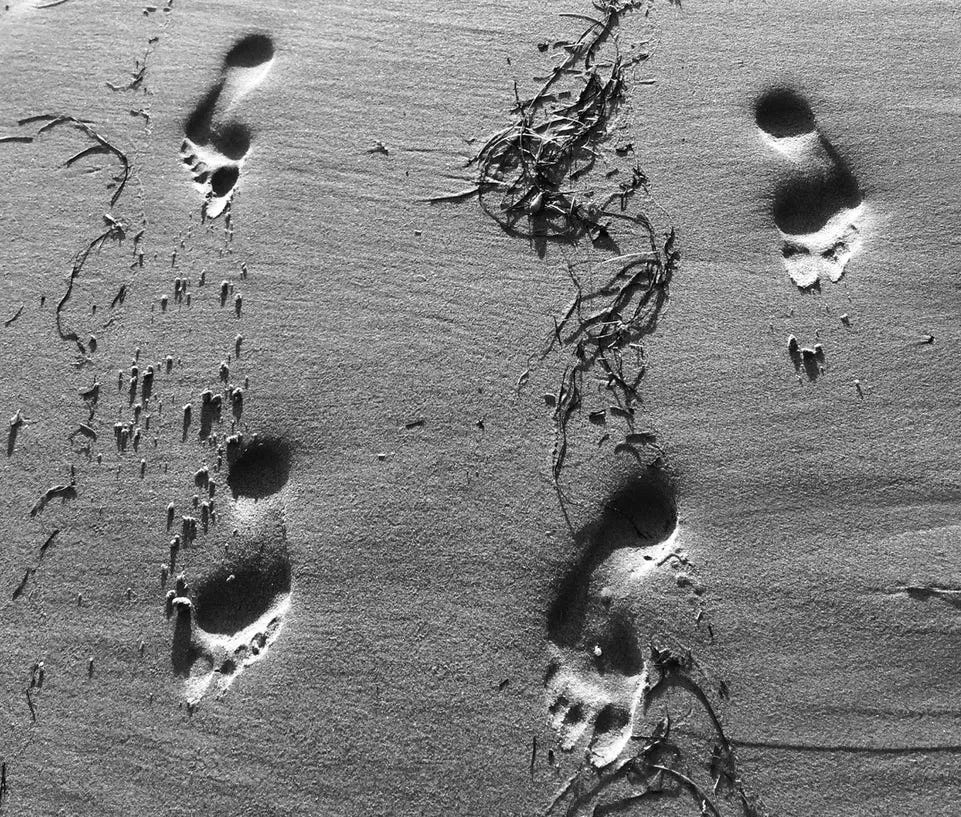
Photo by Don Pierce
There is a point beyond integration where the self stops feeling like a private interior and starts feeling like a field — something relational, rhythmic, and continuous with the world around it. This is the emergence of the ecological self.
The ecological self is not a new identity layered on top of the old one.
It is the reorganization of identity itself.
It is the shift from:
self as story → self as pattern
self as isolation → self as participation
self as defense → self as coherence
self as performance → self as presence
self as mind → self as field
The ecological self is not psychological.
It is relational.
It is the recognition that your identity is shaped not only by your thoughts and history but by the world you inhabit and the world that inhabits you.
You are not a separate mind in a landscape.
You are a living field within a larger field.
This is not metaphor.
It is perception reorganized by steadiness.
When the nervous system stabilizes, the boundaries of the self soften.
Not in a dissolving way, but in a porous, relational way.
You begin to sense yourself as part of a larger system — not swallowed by it, not threatened by it, but held within it.
The ecological self emerges through three shifts:
1. From interiority to field
You stop locating yourself solely inside your thoughts.
You begin to feel yourself in the space around you — in breath, in rhythm, in presence.
2. From self‑protection to participation
You no longer move through the world scanning for threat.
You move through the world sensing relationship.
3. From narrative identity to ecological identity
You stop defining yourself by your past.
You begin defining yourself by your orientation, your rhythm, your coherence, your way of inhabiting the world.
The ecological self is not something you invent.
It is something you recognize once the noise quiets.
It is the self that emerges when you are no longer organized by overwhelm.
It is the self that moves with the land’s rhythm.
It is the self that perceives through pattern rather than fear.
It is the self that belongs without performing.
It is the self that acts without collapsing into urgency.
It is the self that remains coherent across changing conditions.
The ecological self is not a destination.
It is a way of being.
HumaNatureConnect Activity
Sensing yourself as a field
Go to a natural place where space is palpable — an open meadow, a shoreline, a clearing, a hillside, a quiet grove. Sit or stand where you can feel both your body and the space around it.
Let your breath settle.
Let your attention widen.
Then ask, without forcing:
Where do I end, and where does the field begin?
Use these prompts:
What part of me feels like it extends into the space around me.
What part of me feels shaped by the environment rather than separate from it.
What becomes clearer when I sense myself as a presence rather than a boundary.
What part of me feels continuous with the land.
What part of me feels like a field rather than a point.
Stay for ten minutes.
Afterward, write:
What expanded.
What softened.
What connected.
What felt like the ecological self.
This activity teaches identity as a field, not a container.
Nocturnal Pilgrimage
Meeting the self without narrative
Step outside after dark. Night removes the visual cues that reinforce your usual sense of self — the mirrors, the roles, the expectations. In darkness, you meet yourself without story.
Stand or sit in one place.
Let the night surround you.
Use these prompts:
Who am I when I am not defined by sight.
What remains when narrative falls away.
What part of me feels continuous with the night.
What part of me feels like presence rather than personality.
When you return indoors, write:
What remained.
What felt essential.
What felt like the ecological self.
Night reveals identity by removing everything that is not fundamental.
Conclusion
The ecological self is the first movement of this new series — the moment when identity reorganizes around relationship, rhythm, and coherence rather than narrative, fear, or performance.
It is the recognition that you are not a separate mind navigating a world.
You are a living field participating in a larger field.
This is the work of the ecological self:
to inhabit the world as part of it, not apart from it.