

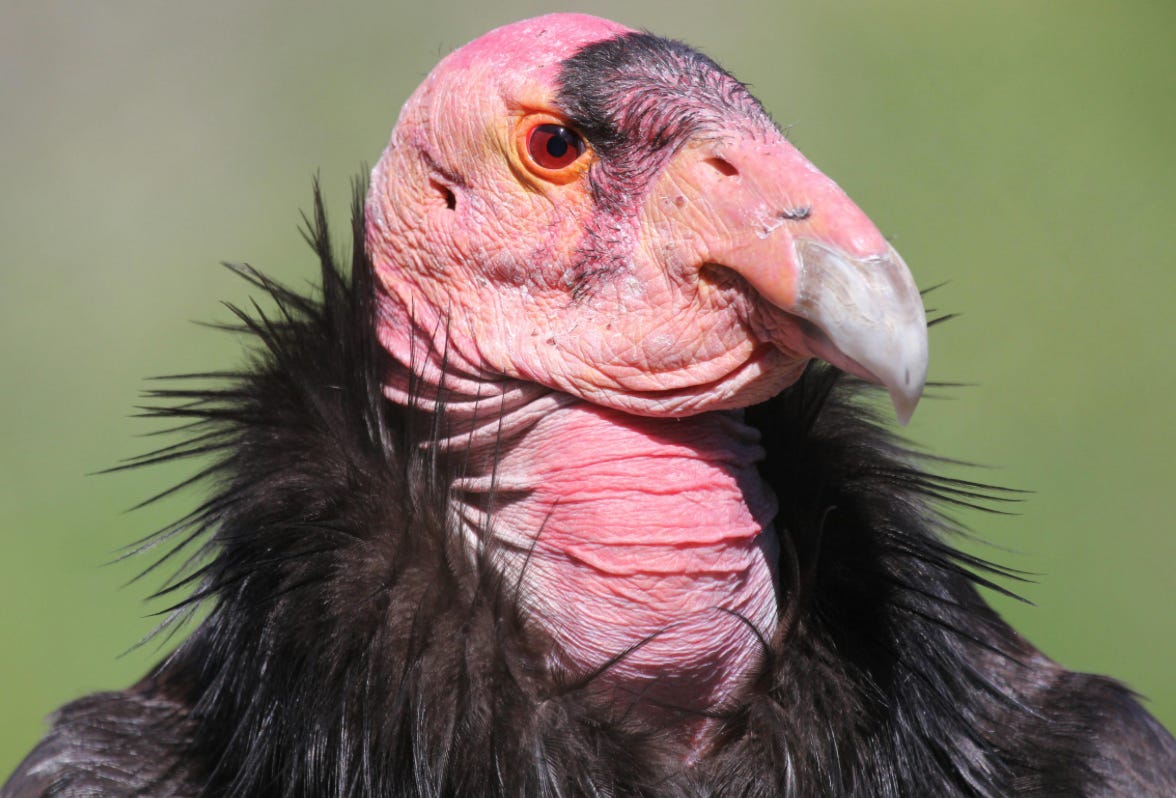
Photo by Richard Block, Pexels.com.
Nothing quite compares to experiencing a condor flying overhead. This behemoth of a bird is almost extinct and making a perilous comeback. Its population, once down to less than 30 remaining, now teeters at about 500.
The California condor is the largest vulture of North America. When soaring close overhead, it is like seeing a mostly silent B1 bomber—huge, impressive, almost bewildering. When it flaps its wings, it is reminiscent of distant thunder. When it dives from up-high, apparently to get a leg-up on some deceased critter, its scream-like voice is, to me, comical; as if to yell “what the hell am I doing?”
In the Eighties, these huge scavengers were all captured. For years, their chicks were fed by zoo-keepers, using parent-looking hand puppets to prevent imprinting. Now, the goal is to keep one third of the population in zoos, one third in or near southern California, and one-third in northern California.
Condors are threatened in numerous ways:
Problem 1. Ingestion of lead when they eat the dead remains of predators that have been killed by the ammunition used in guns to kill so-called “varmints” such as coyotes, bobcats, and golden eagles. This cause of death accounts for about half of the birds’ mortality.
Solution: Ban the use of lead shot projectiles throughout California and wherever condors are present.
Problem 2. Ingestion of micro-trash. Small bits of human refuse (e.g., bottle caps, glass shards, metal) are mistaken for bone or food, especially by chicks. This leads to digestive blockage, impaired growth, or death.
Solution: Design packaging so it does not break down into small bits when discarded inappropriately. Organize clean-ups that focus on picking up the smaller trash.
Problem 3. Collision / electrocution with power lines and other infrastructure. Their large wingspan, and tendency to perch on poles or fly in open terrain, makes them vulnerable to electrocution or collisions. Loss of an adult has major population impacts due to slow reproduction.
Solution: Establish large wilderness areas along the mountain tops from Santa Barbara to Monterey California. Power lines would be prohibited in these wilderness areas. In critical areas, replace existing power lines with new ones designed to be safer for condors.
Problem 4. Habitat modification & food-scarcity. Loss of foraging, roosting and nesting habitat (due to development, land conversion), and decline in suitable carcasses, reduce their ability to survive and reproduce.
Solution: Establish condor refuges through outright purchase or through the establishment of development easements with willing landowners that would prevent incompatible developments, even on private property.
Problem 5. Disease, predation and other contaminants. While less dominant than the above, threats such as poisoning (rodenticides), predation of eggs/nestlings, eggshell thinning from past pesticides, and diseases (e.g., avian influenza) all contribute.
Solution: Ban or restrict the use of certain pesticides. Inoculate birds to fight off avian influenza.
Problem 6. Condors are caught in steel-jaw traps illegally set to catch so-called “varmints.”
Solution: Monitor key habitat areas to make sure the ban on such inhumane mechanisms is being enforced. And, if not, on public land, carefully remove the traps. Promote the alternative of live traps with red flags that tend to not harm condors. Educate ranchers and the public about the value of carnivores. Use the many ways livestock can be protected without the use of inhumane traps.
Essential Readings:
• […]
• […]

Recommended Readings:
• […]
• […]
• […]
• […]

For additional readings, visit Heartwood Path Beat.