

Photos by Don Pierce.
Beyond inner world individual explanations, there are also aspects of social psychology that are pertinent to the topic of protecting the environment.
Since I will have more to say about social psychology later, I will limit my presentation of the impact that others play in our environmental behaviors here to the following twelve points:
What we think and do arise from a mixture of socially determined beliefs, explanations, and rules;
Facts do not usually alter strongly held views, so focus on affecting what people believe ;
Getting people to do the big thing (like attending an environmental meeting) is more likely if you first get them to do a small thing (like signing a petition), in part, because people seek to maintain their public image by appearing consistent;
Pro-environment attitudes are strongest amongst the well educated, the higher social classes, city-dwellers, the young, and women;
It may be nit-picking to say this, but environmentalists may want to reconsider their labeling of the environment as “Mother Earth” because this label implies that humans are the earth’s children and are, therefore, not responsible for their own actions;
When attempting to influence behavior and to encourage the imitation of behavior, the social status of the presenter is as important or more important to the audience than the facts presented;
To influence the changing of another person’s behavior, the activation of personal or social norms is more important than the presentation of information or pleas;
Feelings of moral responsibility have an influence on environmental behavior;
People who spend time in nature with significant others develop emotional bonds to the place they visit and are, therefore, more apt to seek to protect it
The massive amounts of advertising people in developed countries are exposed to makes them feel deprived unless they consume, even though it seems to me that consumption does not deliver what is really important and even though in my experience people are not necessarily happier just because they own more things;
Practicing voluntary simplicity and green consumerism are antidotes to buying unnecessary goods that damage the planet. (Winter and Koger, 2004, pp 57-81).
Rather than thinking that our individual and collective problems are “solely or primarily a result of troubles within individual psyches,” it will be more accurate and productive to . . .“understand that our psychological health relies profoundly on the . . . vitality of our natural environments” (Plotkin, 2013, p. 6).
The answer to how to heal and become whole does not come from suppressing symptoms. Rather, it comes from cultivating wholeness of Self. This cultivation requires a renewed relationship with the More-Than-Human or, said another way, the not-merely-human psyche which, when whole, contains a variety of inner world personality aspects described next.
Some of the key personalities that have an affect on your actions are not other humans. They are instead what eco-psychologist Bill Plotkin calls our four “multifaceted wild psyches” (2013, p. 2):
the “Sub-personalities” –– the numerous “wounded and sometimes hidden fragments of our human psyches,” (2013, p. 14)––, including the so-called inner world Loyal Soldiers, the inner world Wounded Children, the inner world Escapists and Addicts, and the Shadow and Shadow Selves––and the four facets of the Self, the Psychic Personalities ––the inner/outer world Nurturing Generative Adult, the inner/outer world Wild Indigenous One, the inner/outer world Innocent/Sage, and the inner/outer world Muse/Beloved;
the Spirit, (a.k.a. God, Mystery, and the nondual);
the Soul, which is our deepest individual identity; plus
the Ego, one’s inner world aspect that seeks to control the everyday world of family, social, educational, economic, political, and ecological life.
We shall describe each of these Sub-personalities, the Ego, and More-Than-Individual aspects of the psyche (Spirit and Soul) here. We shall also provide an initial activity for how to nurture the first of the four categories of Sub-personalities. Activities for nurturing all the remaining Sub-personalities will be included later in this course. Activities for nurturing the four facets of the Self I call “Psychic Personalities,” which have a more pronounced More-Than-Human aspect, will be included in the next Heartwood Path Course––Ecos.
Each time I discuss the four facets of the Self or the four Sub-personalities I will described them as Plotkin does in his Nature Based Map of the Human Psyche (2013, pp. 22-23); that is, according to the cardinal directions––North, South, East, and West–– and I will also be using my own Medicine Wheel of the Psyche of HumaNature (see the illustration that follows).
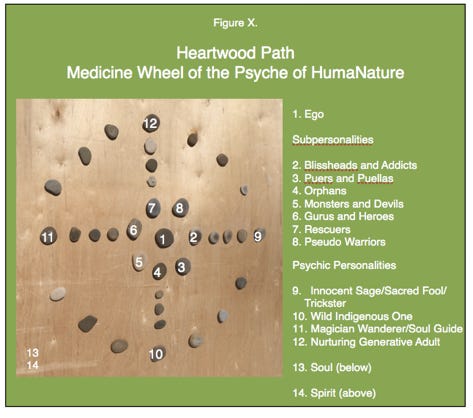
In the Psyche of HumaNature illustration the Ego is represented by the Center Stone, the Sub-personalities are represented by the inner ring of stones, the three-stone lines represent what needs to be done to transition from reliance on immature personalities to mature Psychic Personalities (which are represented by the stones at the Cardinal Directions of North, South, East, and West), and the three stones arcing between each Psychic Aspect represent the activities you can do with your mature inner world/outer world Psychic Personalities.
With all this advising and leading going on, some aspect of the mind has to be in charge, or at least attempt to be. That aspect will be addressed next.
The Ego
Number 1 on the Medicine Wheel of the Psyche of HumaNature is the aspect that typically wants to be in charge. Wanting to be in charge and doing a good job of it are two different things.
Before developing into a mature elder, one’s Ego––one’s seat of conscious self-awareness––is immature (undeveloped) and makes one understand oneself and act primarily as an agent for oneself. As a result, the More-Than-Individual-Self, the Soul, and Spirit, are not typically adequately experienced until later in life, if at all.
The Ego’s all-too-common narrow view is why so many people seem to solely “look out for number one.” With an immature Ego, there is very little sense of belonging to a human community or to an Earth community. One may talk of interdependence, but one does so mainly to look appropriate rather than to be appropriate. Despite its attempt to be an inner world despot, the Ego does not act alone.
The Sub-personalities
The all-too-common immature level of development, which in most people lasts well past the middle years, is a reason why humans give voice to substitutes for their more mature inner and outer world personalities. Plotkin’s “Sub-personalities” may not give the best advice but they do give us the advice we are capable of processing at our less-than-fully mature level of understanding. By basing our behaviors on the feelings and images given to us by our Sub-personalities we are protected from physical, psychological, and social injury. By listening too much to our Sub-personalities, one will contribute to the immaturity and pathology so evident in our mass culture.
This double-edged sword of protection and dependence comes from our early and lingering reliance on the following four categories of Sub-personalities, numbers 2-8 in the Medicine Wheel of the Psyche of HumaNature. With this summary, we shall continue with a description of each type of Subpersonality.
Loyal Soldiers
Loyal Soldiers, which Plotkin places in the northern quadrant of the medicine wheel, act to keep us “safe by inciting us to act small . . . in order to secure a place of belonging in the world” (Plotkin, 2013, p. 19). In this category of Loyal Soldiers, we will focus on the Rescuers (# 7 on the Medicine Wheel graphic) ––“who secure for us a safe place of belonging by prodding us into small social roles (including Caretakers, Enablers, and Codependents) that are useful to or enabling of others”) and Pseudo Warriors(# 8 on the Medicine Wheel graphic), which appear to be successful, not in terms of being in service to the earth’s unfolding (the goal of the Heartwood Path) but rather for the purpose of satisfying family pressures and for the purpose of meeting financial or social ambitions. As a result of these choices, often Loyal Soldiers induce us to suffer from emptiness and despair but they also manage to encourage us to avoid feeling guilty “for how (our) efforts plainly damage the world” (Plotkin, 2013, pp. 133-135). Ways to handle your Loyal Soldiers are presented in the next activity.
One of my dreaming time Loyal Soldiers appeared regularly to me in my youth. This dream image, usually an older peer, would prod me to work to overcome some wrong such as my dreams about a bulldozer flattening my forest playground. As the bulldozer approached one of my favorite trees I would grow in despair in my dream. The Pseudo Warrior, usually hiding behind another tree, would encourage me to somehow cause the bulldozer and its driver to drive off a cliff. This would cause me to celebrate and have no regard about the material damage or death of the driver. I had to tell this Loyal Soldier to go play in traffic when, later in life, I had to convince fellow dam fighters from destroying the equipment building the never-completed Meramec Dam. This strategy of remaining lawful gained much public support for our cause. The river continues to flow free.
Orphaned Wounded Children
Number 4 on this Medicine Wheel marks the spot for the Orphans. Note that these Sub-personalities––which may be conformists, victims, rebels, and princes and princesses––are located by Plotkin in the South quadrant of the wheel––the realm wherein the Sub-personalities help us to satisfy our needs through emotion-filled strategies, albeit immature ones.
If one is too much under the influence of the Orphans of the South, the common remedy––another immature one–– is to pay more attention to the counterbalancing Sub-personalities; that is, the Loyal Soldiers of the North. Mentioning this shortsighted prescription does not mean, however, that one needs to run to the North each time one feels a tinge of emotion.
Be very wary when attempting to manage your emotions. “Emotionality is no more a sign of immaturity than steel-hearted imperturbability is a sign of maturity” writes Plotkin (2013, p 158).
“Affective depression is, at root, the suppression of the South facet of the Self, the blockage of the wild, indigenous, emotive erotic, and fully embodied dimension of our human wholeness” (Plotkin, 2013, 160).
The recommended approach to excessive emotionality if one is immature (as most people at any age are) is to glean messages from the Loyal soldiers of the North. Seeking the wisdom from the opposite side of the Medicine Wheel will be a common approach throughout the next leg of the Heartwood Path. If you want better options and are mature enough to accept them, turn to the Psychic Personality of the South after you finish this course and begin the next Heartwood Path course.
And, if that doesn’t do it for you, look to the mature Psychic Personality (the Wild Indigenous One) on the opposite side of the Medicine Wheel (in this case, The Nurturing Generative Adult).
Maturing is, in part, the process of recognizing, appreciating, and moving beyond all the immature Sub-personalities, which is why we are covering that topic in this course and leaving the deeper and wiser Psychic Personalities for the next course, when, if all goes well, you and the other participants will have an added measure of maturity and thus be prepared to consider whatever good direction is offered.
Included in the ranks of the Orphans are the fearful insiders, such as the Conformists; the fearful outsiders, the Victims; the angry outsiders, the Rebels; and the angry insiders, the Princes and Princesses. You may have experienced anyone or all of these when you were let down by a caregiver who was less than perfect in their caregiving. Being split off, or somehow tossed out of paradise, or suddenly separated and, therefore, needing to make independent decisions is how one tends to come face to face with one’s inner world Orphans.
Each of these wounded, orphaned inner world “children” will provide you with a way to minimize your emotions, and thus protect you from them. This may be temporarily soothing, but it is extremely debilitating in the long run. Instead of moving away from your emotions (which could lead to depression), move more into them. Some assistance is provided in a later Activity, which is about overcoming one’s preoccupation with the intellect (an example of how the opposite side of the medicine wheel––in this case the topic of the intellect––can be used to correct any imbalances––which, in this case, is the appropriate use of one’s emotions). Later on, in the next course, the Wild Indigenous One will be a huge help in this regard.
Personal Example:
How Curbing An Inner Wounded Child Stopped A Nuclear Power Plant
The one Orphaned Wounded Child that appeared most for me before I told it to take a hike was the Rebel. This Dream Image, usually in the form of an unruly teenage friend, would chide me for not perpetually siding with the UnderDog. This Orphaned Wounded Child Dream Image propelled me to march (in full counter-culture regalia) rebelliously against the Viet Nam war, to side vehemently with minorities in discussions about environmental justice, and to play a dirty trick or two on politicians, the Forest Service, the U.S. Army Corps of Engineers, or other “authorities” hell bent on destroying some place I loved. While I keep tabs on the whereabouts of this wandering Loyal Soldier, and may use its advice again when pressed, I feel that following its suggested methods blindly was—and is—is not always the mature response.
In 1976 I told this Wounded Child to take a short, not-too-distanced, hike, and was, therefore, was able to stand apart from my “hippi-billy” friends, who wanted to oppose a proposed nuclear power plant in Missouri by joining a multi-state effort to oppose nuclear power due to safety concerns. I underwent considerable chiding and abuse because I did not think that the safety issue, which I fully endorsed personally, would win in the Sho-Me State. Eventually, I convinced nuclear opponents all over the state to not take the rebellious, safety-oriented approach to fighting nuclear power but to instead take a more conservative means of stopping the power plant by making it illegal to obtain a rate increase to build any utility facility before that facility was on-line. I fully accepted that nuclear power plants were unsafe; but, because the voters all lived at the borders of Missouri and the power plant was in the center of the state, I did not expect the voters––not known to support causes that appeared radical or rebellious––to stop the plant because of safety concerns. Had I followed the Rebel in my dreams and virtually all of my environmentalist buddies, I would have been a follower instead of a leader. Of the dozen or so safety-oriented state referenda that year (1976), all failed at the polls. Unlike all of the other anti-nuclear referenda, the Missouri effort focused solely on making investors fund construction of any utility facility rather than raising construction-work-in progress funds from rate payers. Ours was the only ballot-measure that won, and by a land-slide. In retrospect, I am glad I had the gumption to tell my Rebellious Dream Character and long-haired allies (my own friends) to go march elsewhere. Taking the less rebellious approach made me look like I was “selling out,” but it saved rate payers over a billion dollars and that nuke as never been built.
Addicts And Blissheads
While these images and feelings get us out of Dodge when the going gets rough, some of the methods of innerworld Addicts and Blissheads are dubious, at best. They often help us escape from reality through additions to food, shopping, impersonal sex, TV, gambling, work, drugs and drinking. The Addicts and Blissheads offer relief from pain and various doorways to ecstasy, but their positive effects are always temporary.
Some of their addictions, the ones that are very troubling to many of those who are following the Heartwood Path, are our culture’s mad drives for technological progress at any cost, our individual penchants for over-consumption, and are our personal habits of discarding natural resources mindlessly. Such addictions cause us to live in a world of commodities rather the world of natural beings. We are consumers who are forgetting to be wholly human. Our addictions to economic progress makes us see the Gross National Product as the only measure of progress. Our Addicts and Escapists help us to value profits more than people, money over meaning, and nationalism over peace and justice.
When we become miserable following the addiction of “us over them,” we turn to our Inner Blissheads in hopes of finding rapture and euphoria. Rather than true ecstasy, the Blissheads only offer restricted intimacy, inauthenticity, limited personal development, and a lack of participation in the world.
The adage that if we just think positively enough we will be fabulously wealthy, healthy and happy only works for those who are unconcerned about what such concentrations of goodies will have on other people and the planet. Such egocentric notions keep us immature and separated from our true emotions.
Whether our Sub-personalities are male Puers in the tradition of Peter Pan or female Puellas in the fashion of Wendy, our reliance on such inner world psychic aspects serves to protect us slightly from intolerable emotions and Ego-destroying perils. Despite these protections, rely on these immature Sub-personalities with caution. We cannot expect much more from these immature Sub-personalities than Spiritual Materialism and flights of fancy that keep us soaring away from any possibility of worthy spiritual practice. To escape the realities of our lives is to forsake our destinies. To be blurred by addictions keeps us from finding our fulfillment. Becoming too aerie-faerie keeps us from offering our greatest contributions to a world that presently needs much more from us than immature responses.
My own inner world Blisshead would present herself to me alluringly in my dreams. Her own dream-time sexual availability made me feel, during the time of my life between my first love (1969-1973) and my marriage (1984-1997), that impersonal sexuality (more like serial, essentially always monogamous sexual relationships) was acceptable for a single man prior to the advent of HIV and AIDS. It was not until these epidemics that I had the personal wherewithal to tell my nighttime Siren that her adolescent advice was no longer sensible, fashionable, or safe. Putting plugs in my ears to her nighttime magnetic songs has enable me to, with two regrettable unplanned exceptions, be more enlivened by one good relationship (2000-present) than I was by adding up my conquests.
Fortunately, there are ways to deal effectively with our inner Addicts and Blissheads. In this regard, an activity at Waypoint 2.83, later in this course, will be most helpful.
The Shadow
The West side of the inner circle on the Medicine Wheel of the Psyche of HumaNature is home to an element of our psyches that is often unknown to us; namely, The Shadow. This feeling and inner world image is not what we know about ourselves, but it is what we do not like about ourselves. It is rather what is true about us that we do not know.
The “purpose of the Shadow is to protect us from enacting personal characteristics that, if expressed, might land us in big trouble with others or ourselves,” writes Plotkin (2013, p. 208). Like all Shadows, mine shows up in my dreams and is always just out of sight whenever I try to boast about some accomplishment. Years ago, My Shadow, without me knowing it until I went to a clinical psychologist, made me feel, just under the radar of my own awareness, that I was a person who did not matter. I did not know that I was trying to overcome this subconscious sense of low self-worth (created, in part, by being separated from my own mother every weekend, beginning when I was six months old) by getting many degrees and by helping others to such an extent that, time after time, I hurt my own prosperity. It wasn’t until I was called a “Mad Nurturer” by my therapist that the influence of my own Shadow was revealed. Now that I have been introduced to my Shadow I am now able to let this inner world Sub-personality know that I do, after all, matter. An exercise for how to properly deal with the aspect of yourself that is completely at odds with who you think you are is located at a waypoint later in this course.
To A Better Relationship With Your Immature Psyche…
HumaNatureConnect Activity
Healing Your Relationship With Your Inner World Loyal Soldier
For this activity, begin the work of appropriately moving beyond the immature Sub-personalities, in this case, the Loyal Soldier (which, like all Sub-personalities, were helpful to you in your early stages of development but inevitably will hold you back from effective elderhood).
