
Photo by Pixabay, Pexels.com.
Key Assertions:
Facts do not usually alter strongly held views, so focus on affecting people’s beliefs.
When attempting to influence behavior, the social status of the presenter is as important or more important to the audience than the facts presented.
Getting people to do the big thing is more likely if you first get them to do a small thing because people seek to maintain their public image by appearing consistent.
Beyond inner world individual explanations, there are also aspects of social psychology that are pertinent to the topic of protecting the environment. Since I have more to say about social psychology in the Heartwood Path For Groups course, I will limit my presentation of the impact that others play in our environmental behaviors here to the following twelve points:
What we think and do arise from a mixture of socially determined beliefs, explanations, and rules;
Facts do not usually alter strongly held views, so focus on affecting what people believe ;
Getting people to do the big thing (like attending an environmental meeting) is more likely if you first get them to do a small thing (like signing a petition), in part, because people seek to maintain their public image by appearing consistent;
Pro-environment attitudes are strongest amongst the well educated, the higher social classes, city-dwellers, the young, and women;
It may be nit-picking to say this, but environmentalists may want to reconsider their labeling of the environment as “Mother Earth” because this label implies that humans are the earth’s children and are, therefore, not responsible for their own actions;
When attempting to influence behavior and to encourage the imitation of behavior, the social status of the presenter is as important or more important to the audience than the facts presented;
To influence the changing of another person’s behavior, the activation of personal or social norms is more important than the presentation of information or pleas;
Feelings of moral responsibility have an influence on environmental behavior;
People who spend time in nature with significant others develop emotional bonds to the place they visit and are, therefore, more apt to seek to protect it
The massive amounts of advertising people in developed countries are exposed to makes them feel deprived unless they consume, even though it seems to me that consumption does not deliver what is really important and even though in my experience people are not necessarily happier just because they own more things;
Practicing voluntary simplicity and green consumerism are antidotes to buying unnecessary goods that damage the planet. (Winter and Koger, 2004, pp 57-81).
Rather than thinking that our individual and collective problems are “solely or primarily a result of troubles within individual psyches,” it will be more accurate and productive to . . .“understand that our psychological health relies profoundly on the . . . vitality of our natural environments” (Plotkin, 2013, p. 6).
The answer to how to heal and become whole does not come from suppressing symptoms. Rather, it comes from cultivating wholeness of Self. This cultivation requires a renewed relationship with the More-Than-Human or, said another way, the not-merely-human psyche which, when whole, contains a variety of inner world personality aspects described next.
Some of the key personalities that have an affect on your actions are not other humans. They are instead what eco-psychologist Bill Plotkin calls our four “multifaceted wild psyches” (2013, p. 2):
the “Sub-personalities” –– the numerous “wounded and sometimes hidden fragments of our human psyches,” (2013, p. 14)––, including the so-called inner world Loyal Soldiers, the inner world Wounded Children, the inner world Escapists and Addicts, and the Shadow and Shadow Selves––and the four facets of the Self, the Psychic Personalities ––the inner/outer world Nurturing Generative Adult, the inner/outer world Wild Indigenous One, the inner/outer world Innocent/Sage, and the inner/outer world Muse/Beloved;
the Spirit, (a.k.a. God, Mystery, and the nondual);
the Soul, which is our deepest individual identity; plus
the Ego, one’s inner world aspect that seeks to control the everyday world of family, social, educational, economic, political, and ecological life.
We shall describe each of these Sub-personalities, the Ego, and More-Than-Individual aspects of the psyche (Spirit and Soul) here. We shall also provide an initial activity for how to nurture the first of the four categories of Sub-personalities. Activities for nurturing all the remaining Sub-personalities will be included later in this course. Activities for nurturing the four facets of the Self I call “Psychic Personalities,” which have a more pronounced More-Than-Human aspect, will be included in the next Heartwood Path Course––Ecos.
Each time I discuss the four facets of the Self or the four Sub-personalities I will described them as Plotkin does in his Nature Based Map of the Human Psyche (2013, pp. 22-23); that is, according to the cardinal directions––North, South, East, and West–– and I will also be using my own Medicine Wheel of the Psyche of HumaNature (see the illustration that follows).
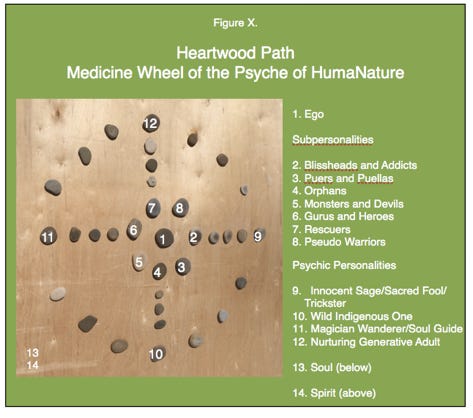
In the Psyche of HumaNature illustration the Ego is represented by the Center Stone, the Sub-personalities are represented by the inner ring of stones, the three-stone lines represent what needs to be done to transition from reliance on immature personalities to mature Psychic Personalities (which are represented by the stones at the Cardinal Directions of North, South, East, and West), and the three stones arcing between each Psychic Aspect represent the activities you can do with your mature inner world/outer world Psychic Personalities.
With all this advising and leading going on, some aspect of the mind has to be in charge, or at least attempt to be. That aspect will be addressed next.

Photo by Photo by Helena Lopes, Pexels.com.
HumaNatureConnect Activity
Healing Your Relationship With Your Inner World Loyal Soldier
For this activity, begin the work of appropriately moving beyond the immature Sub-personalities, in this case, the Loyal Soldier (which, like all Sub-personalities, were helpful to you in your early stages of development but inevitably will hold you back from effective elderhood). With your attractive natural being by your side, evoke a sense of compassion by bringing fourth, to the best of your ability in this early section of the Heartwood Path, what you feel to be Spirit, Soul, Self, and Ego.
What is important here, as it will be often throughout the balance of the Heartwood Path, is to adopt a perspective that the ecological realm or the part of the universe that contains all sentient beings is primary while your own individuality is secondary. This will naturally evoke a greater sense of empathy and compassion for others, key elements in doing all of the Sub-personality Activities. From this vantage point, identify one of your Loyal Soldiers, a set of images and feelings, that you encountered in recent memory. Perhaps, for example, you were offered a new job and you decided not to take it because your Loyal Soldiers told you that taking the job will lead to embarrassment or disgrace. Name this Loyal Servant. Bring this Sub-personality vividly into your imagination. Thank this Servant for keeping you safe by keeping you small. Out loud, tell your Loyal Servant that you see how her survival strategy was helpful. Then offer your gratitude for how this advice kept you safe. Next, tell your Loyal Servant that the War of Childhood Survival is about to end because soon you will have new strategies. Ask her to stay around in case she is needed during your ongoing pathway of personal development. Tell her that in the future you are going to evoke other inner and outer world resources. Tell her that you will soon be protecting yourself in a more effective way. Create a ceremony to honor your immature protector. Give her a full and honorable discharge. Ask her to remain vigilant, just in case.
Record in your journal what you did, how you felt, and what you learned. Continue on your pathway of growth. You will be doing another Sub-personality Activity soon.

Photo by Helena Lopes, Pexels.com
Nocturnal Pilgrimage
Before starting another waypoint, keep sleeping, dreaming, and tending to your dreams--nighttime and daytime. Look over your dream journal for visitations of Indigenous Images. Make sure these images are natural and not imposed upon you by the media and advertisements.