

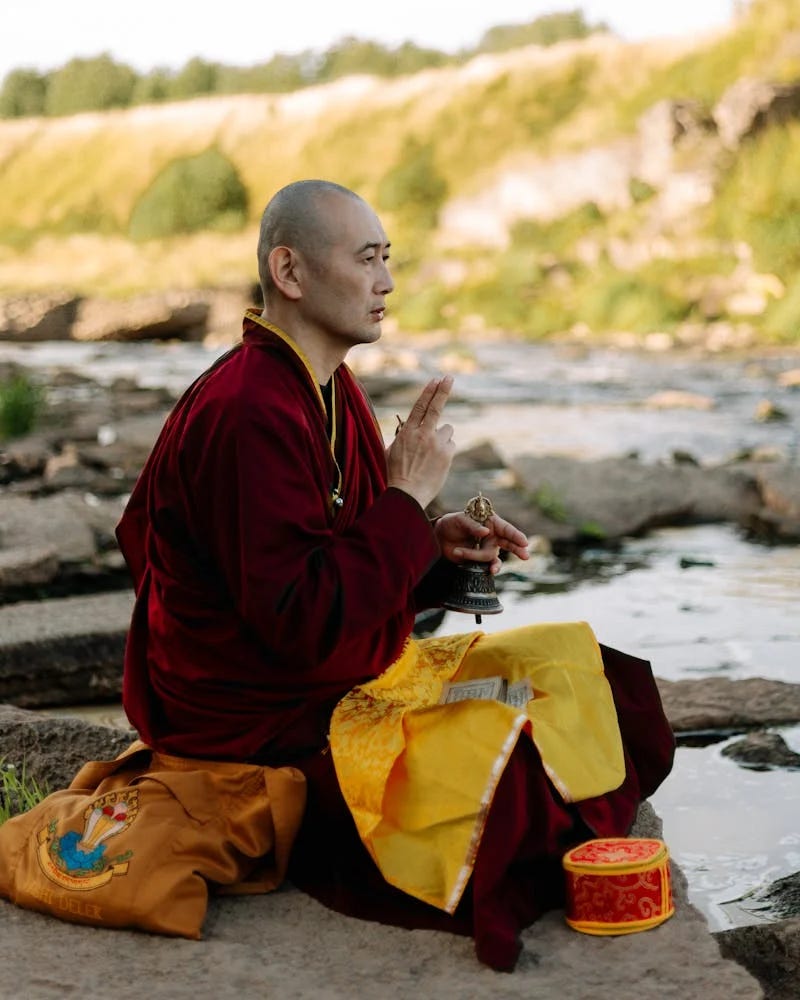
Photo by Cottonbro Studio, Pexels.com.
Key Assertions That Help To Summarize This Article:
Use sound to find the wellness that comes from elemental flexibility, the flexibility to change, and the ability to convert the stress of this change into euphoria.
Use mantras, conscious breathing, and hand gestures to create a more harmonious inner world, which will then improve the outer world.
Promote samadhi not because you care little about this world but because it helps to liberate oneself from self-induced suffering and because, once suffering is minimized, one can devote more attention to helping others, including all sentient beings.
When you use mantras focus on the vibrations of the sounds and not their meaning.
Certain sounds or sound phrases, some of them musical, are useful; but if you want to pinpoint the emotion, feeling, or ailment you are dealing with, use or create your own mantras out of the Bija Mantras or “seed sounds.”
As you seek wholeness (perfection), experience pleasure, and laugh you begin to perceive wellness. Perfection-seeking, as long as it is pleasurable and lighthearted as opposed to excessively concerned with a preconceived preoccupation with a goal imposed by others, moves a person along Dr. John Travis’ Wellness Continuum; that is, away from premature death, disability, symptom of illness, and signs of ill-health to education, growth, self-actualization and a high level of wellness. “Wellness,” writes Travis, “is an efficient channeling of energy--energy received from the environment, transformed within you, and sent on to affect the world outside” (Beaulieu, 1987, p. 22). This channeling is precisely what happens along the Heartwood Path. We will be using sound to find the wellness that comes from elemental flexibility, the flexibility to change, the ability to convert the stress of this change into euphoria.
In many of the activities that follow you will be asked to hum a tone or say “Om.” This sound is the king of mantras. It is an ancient resonance that provides a sort of sonic womb. It is recommend that you say “Om” in a droning or muttering fashion that generate undertones—which commonly occur when you speak in a low voice, whisper, or mutter (vocalize under your breath). “Om” can be orally drawn out in a series of three sounds “A,” “U,” and “M.” But let us not forget that there is an important silence after the droned “OM. ” “A” corresponds to the waking state, “U” to the dream state, “M” to deep sleep, and the silence after the “OM” to “the state of turiya, a field of spacious consciousness considered vital to the development of yogic power because it encompasses waking, dream, and deep sleep states in concurrent continuity” (Paul, 2004, 180).
In order for “anything to exist it has to be in motion, vibrating” (Paul, 2004, p. xx). If “any object is in motion, it is producing a frequency—a specific tone” (Paul, 2004, p. xx). “Life is vibration, tone, and rhythm. In this sense, everything is alive.”
Music “is the organization of specific tones or frequencies, located at specific distances—or musical intervals—from each other” (Paul, 2004, p. xx). Music is “the perception and understanding of the underlying order and relationships among all these vibrations, expressed in melody, rhythm, and harmony” (Paul, 2004, p. xx). Unpleasant (discordant) vibrations “will configure our inner world. Conversely, inner turmoil manifests as a manic outer world” (Paul, 2004, p. xx).
Treading down the Heartwood Path enables you to become a postmodern sonic yogi. You will become aligned with the harmony of the universe through the use of postures and mantras. You will be appreciative of the sacredness of all parts of the human body. You will become devoted to humaNature, to one’s neighbors, and to the Divine. And, you will become complete with a crucible-like heart that is capable of transforming the self and the world.
Mantras, both the articulated external sounds one hears with one’s ears and the radiant power awakened in one’s heart when the sounds resonate rightly, awaken us to vast fields of consciousness. They connect one’s soul to the energy that emanates from the governing vortexes of energy called “chakras.” Such connecting allows us to absorb Divine attributes into ourselves and, in so doing, aspire to our highest good. Mantras are specific tones or tone phrases which are a means to good ends, and these ends are wholeness, happiness, perfection, and health. These sacred sounds are, thus, an important augment to medicine and any program of personal or social improvement.
We will use mantras as an antidote to the right-brain, ego-dominated lives that one’s reliance on sight exaggerates. The ego-controlled analytical right brain is about doing, often doing that which one ought not to do. We will be using mantras to activate the soul-controlled artistic left brain, which is more about being, being in touch with the soul, and being the way one ought to be. Such ways of being involve ethics, a major theme of this book series.
Our use of mantras will focus on the vibrations of the sounds and not their meaning. While many mantric phrases are Sanskrit words that are translatable into English, we are in this course of study focusing on the sound as an aspect of nature, as an aspect also of our deeper nature, and not as an aspect of human language. We will, therefore, be looking for Spirit in sound by toning sounds more than we will be chanting words––Sanskrit, English or otherwise. We are here connecting mostly with nature and not so much with man-made words, for reasons that will be presented subsequently. It is the sensual experience, the vibration, the music of the spheres, and not the linguistics or the human-oriented meanings that we will be highlighting. Nature does not need our words for its vibrations to work its magic.
In our yoga of sound, we will not be concentrating on human-generated words much at all. Such words are too often communicated without feeling, which will not work for what we are attempting to accomplish––the attainment guidance from undivided humaNature. We will instead employ the deeper significance of “Vak,” the sounded “speech of all things”––the underlying “language” of nature. It comes in levels of manifestation that correspond with states of consciousness. There are four levels, only one of which is the audible sound normally associated with oral speech, music, and other vibrations that resonate in the ears.
The first stage mentioned here we shall call the Articulation Level Of Vaikari Vak. It is the one where manifested beings make audible sounds: people gives speeches, turtles make short “Whoosh” sounds when they close there shells, trees “creak,” in the wind, and humpback whales “sing.”
The second stage is more subtle. Here, the vibrations from the Source present themselves as images and thoughts. We shall call this stage the Thoughts and Images Level Of Madhyama Vak. Preceding this level is the next step in the unfolding of the manifest world.
The third stage presents to the meditative and still Heartwood Path wayfarer perceptions on the inner world stages of their awareness. We shall call this stage in the unfoldment of nature’s speech (vibrations, including sound) the Perception Level Of Pashyanti Vak Coming from the undifferentiated, unformed Source, the vibrations of our next stage actually starts this whole process of unfoldment.
As the primordial I-Am, the forth stage presents the wholeness of all potentiality. It precedes perceptions, thoughts, images, articulated sounds, and formed things. We shall call this stage the All Potentiality Level Of Paraa. This stage is pure awareness, the Self, in which ever of these ways you chose to think about it is often overlooked, Paraa—the silent background from which all expression (and all differentiation) emerges is largely forgotten because we devote so much of out time witnessing manifest vibrations such as sounds from commercials on television.
The diversity that emerges from the oneness of everything springs from the way each aspect or being within the universal field expresses itself, sometimes through sound, sometimes through thoughts and images, and sometimes through perceptions.
The “Vak” sounds we will be using are like preprogrammed vessels guided in their sonic meter and nuance to merge with the sound of The Absolute Spirit known as “Shabda Brahman.” In doing so, we will be replacing words, often laced with negativity, with the Vak sounds of Shabda Brahman that are positive and engender peace, trust, universal belonging, and love.
Given the condition of the world, we can no longer communicate solely in a medium that relies on the abstract form of words, on a medium that allows us to converse without feeling. The job for eartHearts will be to rebuild our lives with the signifying sounds of “Vak,” sounds that allow us to feel fully as we communicate with audible sounds, with comprehended gestures in silence (nodding of heads, for example), and even with the ultimate vibration, our own echoing of the “Huge Hum” (also known as the Big Bang), used by the Divine to evoke creation. Within this hum is the harmony the world needs.
The need for mantras is great. Their power is needed now.
We are using sounds that come from humaNature. Be open to using mantras inspired by nature sounds. Feel the mantras as vibrations.
Focus on the effects of the mantra and not so much on what they mean in human words. To translate the mantra is to bring into the process the distraction of applying concepts when really it is feelings that ought to be examined.
Translating mantras brings in the complication of reflecting in a narrow and shallow human way. These sounds deserve more. They are, after all, sounds that come from a broad and deep More-Than-Human source.
Pay attention to how, if at all, they pull together various aspects of your self into a state of wholeness. Pay attention to how, if at all, the mantras reconnect you with your highest truth. Judge for yourself their usefulness and truth.
Certain sounds or sound phrases, some of them musical, are useful; but if you want to pinpoint the emotion, feeling, or ailment you are dealing with, use the following system to create your own mantras out of the “Bija” or “seed sounds” (listed in the paragraphs that follow). Each seed sounds evokes a chakra and a particular transcendental element, allowing it to go to work on the job of healing.
Bijas used to facilitate the flow of energy in the lower three chakras are “lam,” “vam,” and “ram.” Bijas used to facilitate the flow of energy in the fourth, fifth, and sixth chakras are “yam,” “ham,” and “om.” The crown chakra responds to silence––the Sonic Absolute.
Mudra Hand Gestures
To strengthen the power of the mantra consider using hand gestures. When doing so know that the thumb represents the Divine and the index finger—the one next to the thumb—represents the human soul. There are too many mudras to describe here. We will, however, point out the mudra where the thumb and the index finger are joined, indicating the act of yogic union or the yoking of the individual with the collective. The other fingers represent aspects of nature: the middle finger, purity and light; the ring finger passion and fire; and the little finger, darkness and inertia. For receptivity or to facilitate the flow of energy from the base of the spine to the top of the head, place the hands, thumbs touching the index finger, on the thighs with palms facing up. For groundedness or to facility the flow of energy in the other direction, place the hands on the knees with the palms facing down. Use the palms down mudra if you feel too flighty and need to become grounded. Use the palms up mudra if you feel too drained and need to raise your energy.
Conscious Breathing
Through a certain form of intentional breathing one can release the most primal form of the life force—kundalini (described in detail in the Heartwood Path for Couples book). Like a river flooding fields after gathering water from tributaries on its way to the sea, the kundalini fertilizes every level of one’s being.
We will be working directly with the Vak speech of nature in Waypoint 2.56. But before you get to a portion of the Heartwood Path that could give you a glimpse of what it would be like to be an enlightened sage, there is important work to be done. Namely, use the following practice…

Photo by Roman Odintsov, Pexels.com.
HumaNatureConnect Activity
Flooding The Fields Of Your Nervous System With Vitality
For this activity, revitalize your nervous system using the following method: Sit on the ground next to your chosen attractive natural being. Relax. Pay attention to the breath entering and leaving your body. Take in one long breath (all the way down to the body) and hold it for an instant. When exhaling, let out your air controllably through the mouth, first from the top of the chest and lastly from the belly, forcing the last of it out by contracting your abdomen. The breath coming out of the mouth is made audible by maintaining “a slight pressure in your throat so that the contracted glottis can regulate the outflowing air . . . The effect is like the sound of an ocean wave” (Paul, 2004, p. 167). This “great yogic breath is essential to deriving the maximum energy from toning vowels—particularly when intoning the sacred syllable “Om” (Paul, 2004, p. 183).

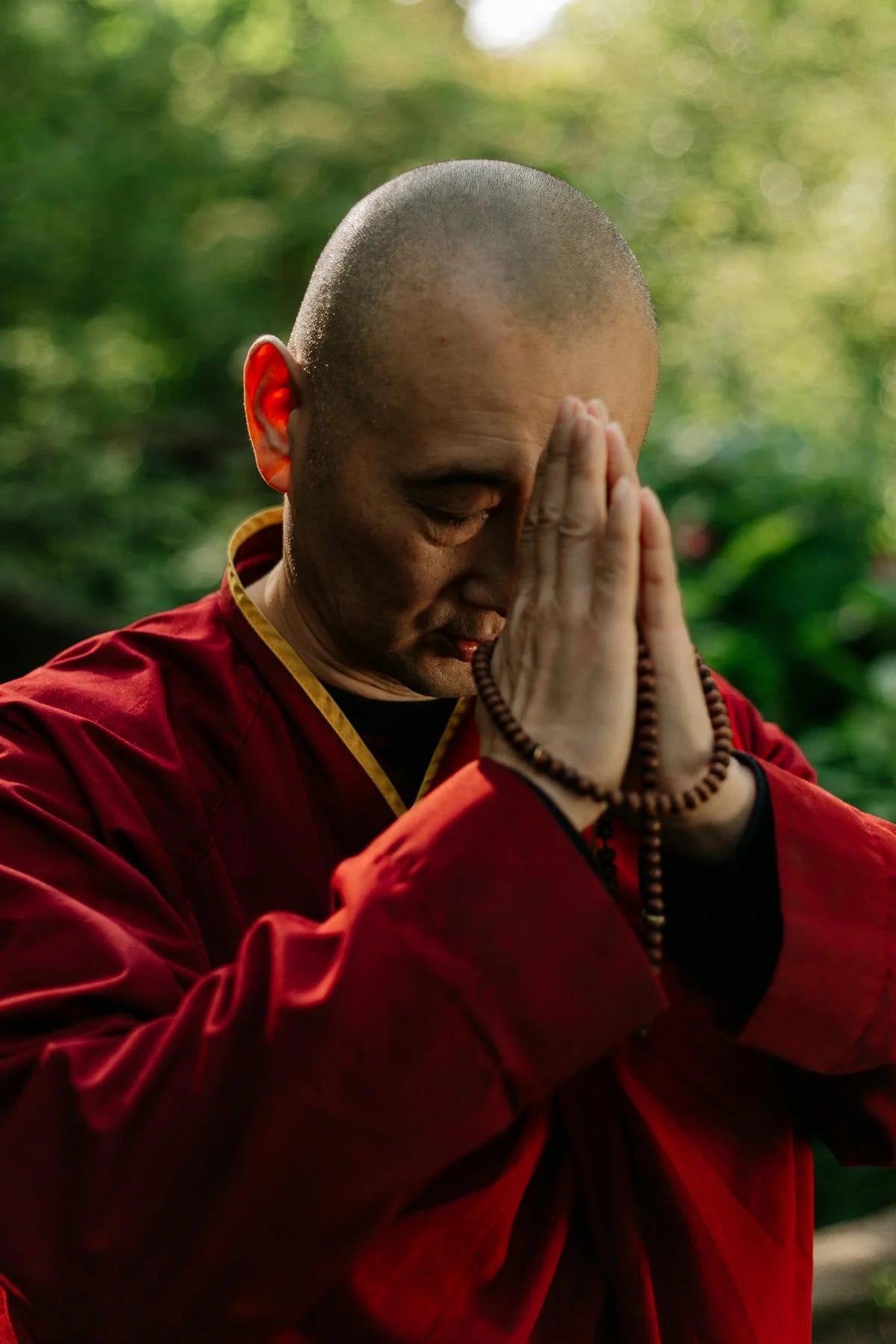
Photo by Cottonbro Studio, Pexels.com.
