

Photo by Quackersnaps, Pexels.com
Key Assertions: Attunement is a portal to the Soul that requires confidence in one’s own ability to make an inner opening—a blank space in the psyche where one can place a newly refined level of sensitivity. The blank space in the psyche needed to create a Portal to the Soul is created by temporarily disengaging from one’s own fascination with the physical world; and, in the place of this blankness is the acceptance of many “affordances” from the spiritual realm, including: an expanded awareness of the magnificence of life; an inner power you can use to balance the strong influences of the outer physical world; and an ability to project yourself in your imagination beyond your present experience of yourself as a human being. During this More-Than-Individual experience of your Self you will experience: Greater Self-confidence, strength, power, and increased creativity; a wonderful feeling of belonging that is based upon an enlightened awareness of new bonds of love that you are continually weaving with the loved ones in your life, and a deep sense of joy and fulfillment as you express yourself with greater freedom.
Each person undergoes spiritual development, a long climb towards fulfill fulfillment. How far you go in this development becomes your spiritual formation.
We all begin at a level where we gain fulfillment through fight or flight responses involving family, community, a sense of belonging, and material comforts. Most of us add to this level of develop reactive responses that are attempts at fulfillment through success, power, influence, status and other ways to satisfy our egos. Some of us may hold on to the flight or flight responses and the reactive responses but temper them with restful awareness responses that have to do with finding fulfillment through peace, centeredness, self-acceptance, and inner silence. Thinking this level of development was the highest plateau, I, for example, remained at this level for over thirty years. It wasn’t until I began to find fulfillment through insight, tolerance, and forgiveness that I saw glimpses of my higher potential. Such peak experiences sometimes come through unpleasantness. I am recalling a conversation I had during my Thirties wherein I was informed of the difference between sympathy and empathy (as I was told, sympathy is getting someone a drink of water; empathy is sharing in the feelings of being thirsty––well, excuuuuussse me). Apparently, since I did not know what empathy was, I had not yet reached the fourth level of spiritual development. I certainly did not know that there was three more possible stages. This portion of the Heartwood Path is a metaphorical climb up seven distinct branches of spiritual development on something similar to Jack’s beanstalk in the popular children’s fable (See Figure 5.).
While there is nothing someone can do to guarantee that one will move to a certain level of development, what follows gives you a very good map for the course of your spiritual development (the Beanstalk of Spiritual Development) and what psychospiritual work one will need to do to move to each stage of growth (working on overcoming certain dilemmas identified shortly).
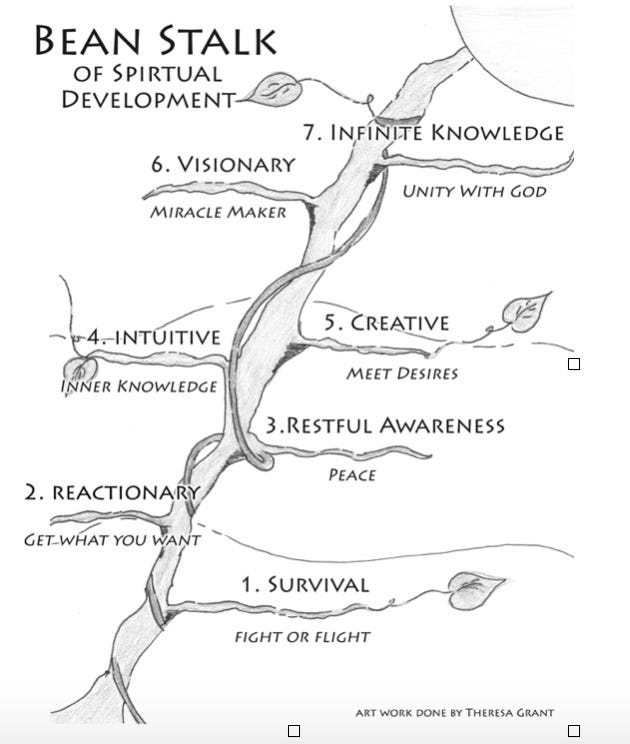
The Beanstalk of Spiritual Development is a fitting metaphor because, like Jack who climbed from his backyard to the clouds, we move, step-by-step, from the tribulations of our earthly existence to God’s Heaven or the Realm of The Absolute Spirit. In our beanstalk model of spiritual development each person’s step up from one branch to another breaks the boundaries of the previous level.
The Beanstalk of Spiritual Develop is inspired by Dr. Deepak Chopra’s rungs of spiritual development as described in his excellent book, How to Know God (2000). In honor of the way Chopra wrote his book, we shall in this section often use the Judeo-Christian term for The Absolute Spirit: “God.”
Writes Chopra, “God is another name for infinite intelligence ” (1999, p. 16). As we make achievements in our lives and as we grow spiritually, we come to know, little by little, more of God, more of infinite intelligence.
Branch One
At the first level, the one described in this waypoint, life becomes fulfilling through family, community, material comforts, and a sense of belonging. Hiding the onset of deeper spiritual beliefs, one is likely to an atheist, a cynic. or a failed seeker. Life is experienced as full of danger, threat, and struggles for survival. The chief way one responds to life is through fight-or-flight reactions. One’s fall-back emotion is anxiety. One’s identity is tied to the physical body and the physical environment. God is seen as The Protector. One holds onto this stage of separation by say, in effect, “I am in such separation that I sense deep fear inside.”
Branch Two
At the second level, life become fulfilling through success, influence, power, status, and various ways to satisfy the Ego. Hiding from deeper spiritual beliefs, one is likely likely to be a leader who is and achiever but also a skeptic. Key life experiences have to do with striving, competition, and power. One’s fall-back emotion is anger and obstinacy. The main way one responds is reactive. One’s identity is tied to one’s Ego and personality. God is seen as The Almighty. One begins to lose this stage of separation by say, in effect “I don’t feel so separate, I am gaining a sense of power.”
Branch Three
At the third level, life becomes fulfilling through peace, centeredness, self-acceptance, and inner silence. As a thinker and dreamer, life becomes peaceful and calm. There is time for reflection. The tell-tale way one responds is through restful awareness (like when you are quietly visiting a natural being at the beginning of each waypoint along the Heartwood Path). One’s identity becomes a silent witness. God is seen as Peace. One begins to move from this stage of separation when one begins to say, in effect: “Something larger than me is drawing near, I feel much more peaceful.”
Branch Four
At the fourth level, which may not be known to some younger Heartwood Path participants, life becomes fulfilling through insight, empathy, forgiveness, and tolerance. One’s fall-back emotion is a healthy detachment. As an idealist and a liberator, one is nonjudgmental and defies normal expectations. Being insightful, understanding, and forgiving come to the forefront. The main way one responds is through intuition. One becomes a co-creator with God. God, who is seen as The Redeemer. One may be on the verge of the next level when one begins to say, in effect, “I am beginning to intuit the Nature of God.”
Branch Five
At the fifth level, life becomes fulfilling through inspiration, expanded creativity in art and science, and unlimited discovery. As an artist, adventurer, and explorer, one has a tendency to be emotionally resilient and sensitive. Aspirations, creative outlets, and discovery are the notable ways life is experienced. The dominant way the few who achieve this level of spiritual development responds is through creativity. Enlightenment illuminates one’s identity. In this light, God is seen as The Creator. A sign that one may be ready to move to the next level occurs when one begins to say, in effect: “My actions and thoughts are drawing on God’s force field and we together are creating the future.”
Branch Six
At the sixth level, which marks the enduring destination or outcome of the Heartwood Path, life becomes fulfilling through reverence, compassion and universal love. One’s tell-tale experiences at this level have to do with reverence, and compassion. One’s fall-back emotion is love. As a prophet and redeemer, one humbly sees the depths of any person or situation. The main way the visionary ones at this lofty level respond is through devoted service. God is seen through Miracles. You will know that you are approaching the end of the Heartwood Path when you begin to say, in effect: “God and I are almost together now.”
Branch Seven
This level of spiritual development for those who follow the Heartwood Path is typically only experienced as temporary peak experiences, just long enough to achieve a momentary but profound glimpse of wholeness and unity with the divine––that is, with God or the Absolute. Unbounded unity is the experience that tells the pilgrim on a spiritual development path that one is, at least, peaking over the threshold of this level. One’s indicative responses are of sacredness. One’s fall-back emotion is compassion. One merges with the source of all. Oneself and God are unified as Pure Being. Your tell-tale sign that you have achieved the last level of spiritual development may come as a fleeting impression that there is no difference between you and God.

Photo by Roman Biernacki, Pxels.com.
HumaNatureConnect Activity
Determining Your Level Of Spiritual Development
For this activity, in what ever fashion you like, answer the following questions. Do not worry if you seem puzzled by these questions at this time. Some helpful guidance follows, beginning in the next Nocturnal Pilgrimage section.
It is always a treat to see what you are learning. You will be given directions in more elaborate ways of answering the following eight questions in the following seven waypoints. It will be interesting to compare the answers you give here, prior to tutoring, to the post-tutoring statements you give concerning topics related to each question in the next few waypoints.
Who am I?
How do I fit in?
What is the nature of good and evil?
How do I find God?
What is my life challenge?
What is my greatest strength?
What is my biggest hurdle?
What is my greatest temptation? (Chopra, 2000, pp. 51-179)

Photo by Elena Golovchenko, Pixels.com
Nocturnal Pilgrimage
Tend To Your Dreams Before Heading To The Next Waypoint
Sleep, dream, and tend to your dream before learning how to ascend, branch by branch up the ladder of spiritual growth. This topic is covered at the next waypoint.
But before you go there and begin your next daytime activity, understand how to use the Tree of Life in your nocturnal reveries.
Put The Tree Of Life To Good Use
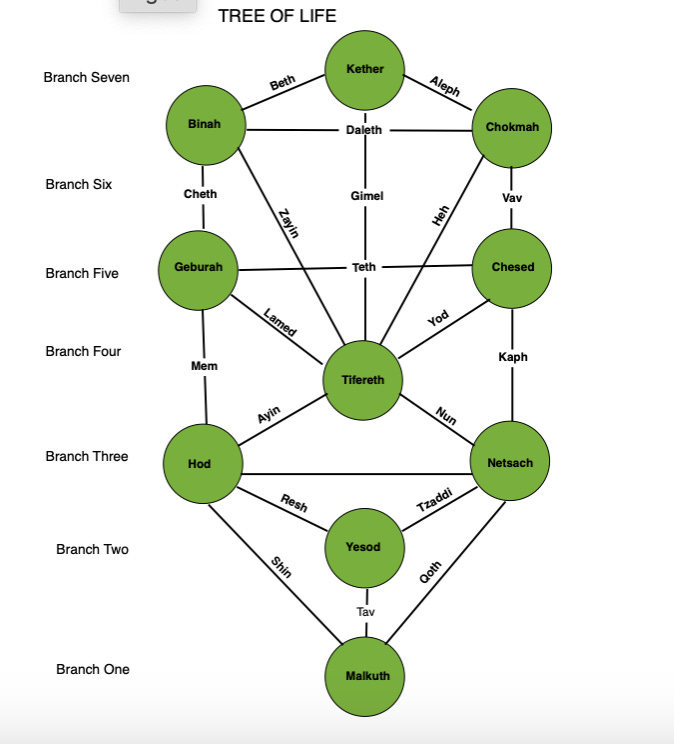
In the next seven Nocturnal Pilgrimages we will present correspondences between dreams and the various stops and pathways of the Kabbalist’s Tree of Life, shown above. We do this because certain dreams tend to be indicators of one’s spiritual development, not perfectly, but at least enough so that one can monitor one’s development through one’s dreams.
We will be stating what your dreams may be indicating. We say “may” because you may have a different interpretation. By linking one’s dreams to the various locations in the Tree of Life we are not claiming (or denying) anything magical, just as we are not claiming nor denying anything magical about Native American Medicine Wheel, the Hindu Sri Yanta, or any other forms of sacred geometry allayed along the Heartwood Path. At the least, the associations that are presented here, which come largely from Jonathan Sharp’s book Divining Your Dreams, are included here just to get the participant’s minds working on possible interpretations. Feel free to take the dream interpretations submitted in the following tables with a grain of salt. The interpretations are certainly not presented here as a way to condense the meaning of your dreams down to any set explanation. Do not impoverish the meaning of your dreams by attempting to prematurely interpret their meaning. Often, hasty interpretations deplete the real world by replacing it, or aspects of it, into a duplicate, shadow world of “meanings.” Instead of merely relying on hastily made duplicates that are made of premature interpretations, favor the experiencing of what is before you. Do not make your dream tending only a process of solving riddles or problems. Instead, make your dreams and your dream tending mysteries to be experienced. In dream tending as in living your daytime life, favor experiencing being alive over pigeon-holing your life into the tunnel vision of problem-solving. That way your life and your dreams will have resonance with your innermost being and outer world reality. Having said this, I do feel that the interpretations in the following seven tables are worthy food for thought. They may help you find certain solutions. Just be sure not to let them squelch out the rapture of being alive. You and your dreams will always be more than your constructed definitions or conclusions.
For this reason, always will your “known self” be a fiction. Rather than minimizing yourself into a capsulated “known self,” seek instead to center yourself in the realm of the present. You cannot be both a fiction and an actual presence. Choose to be present.
We will, in the last course, present an integral, non-interpretive way to make sense of one’s dreams. This integral approach, which includes the Dream Tending methods presented by Dr. Aizenstat, will be most helpful in using your dreams to glean guidance from your nature connect activities or any other aspect of your life. But, for now, use the following dream associations as a footing, as a way to begin your own process of tending to your dreams. These associations will provide a useful component, rather than a “be all, end all,” to your overall dream tending approach.
Now for a few words about the Kabbalist’s Tree of Life. The circles you see on the Tree of Life represent universal forces. Note that there are levels (some horizontal and some diagonal) which I have associated to our Branches of the Beanstalk of Spiritual Growth. The forces that form the right column have to do with action and wisdom. The forces on the left have to do with receptive intelligence and understanding. At the top of the Tree of Life is Kether, the highest level of spiritual development. Below it are Binah, which represents understanding and Chokmah, which represents wisdom. The Sephorot I have associated with Branch Five include Chesed, which represents mercy, and Geburah, which represents strength. I associate Tiffereth, which represents beauty, with the Fourth Branch of Spiritual Development. Branch Three is correlated with both Hod, which represents glory and Netsach, which represents victory. Yesod, which I correlated with Branch Two, stands for foundation. For the First Branch, I place Malkuth, which represents kingdom. In these associations, one may notice some further correlations with the seven chakras. In the interest of moving ahead, I will hold on this discussion; but it will be included in the course called Eros. Between the various Sephorot are twenty-two pathways. As you dream, it will likely help you tend to your dreams by noting which of these pathways Jonathan Sharp associates with your dream characters. As you continue to commune with nature it is reasonable to assume that, more and more, natural beings will be present in your dreams. In the tables presented here you can see how Sharp associates some of the natural beings in your dreams with the various Tree of Life Sephorot, which represent the forces previously mentioned, and the pathways between the Sephorot, which represent various life situations, as follows:
Tav, serving consciousness, administrative intelligence, power/servitude;
Ayin, natural consciousness, renovating intelligence, mirth;
Qoth, perpetual consciousness, corporeal intelligence, sleep;
Mem, eternal consciousness, the garden of pleasure, stable intelligence, water;
Samekh, exciting consciousness, temperance, tentative intelligence, anger;
Tzaddi, corporeal consciousness, constituting intelligence, imagination;
Lamed, consciousness of will, faithful intelligence, work;
Nun, faithfulness consciousness, imaginative intelligence, movement;
Resh, consciousness of trial, collecting intelligence, fertility or barrenness;
Yod, consciousness of disposition, the foundation of beauty, willful intelligence, sexual love;
Peh, consciousness of the desired-which-fulfills, exciting intelligence, grace/indignation;
Aleph, perfect consciousness, the plan of the primordial, scintillating intelligence, air;
Teth, scintillating consciousness, spiritual intelligence, taste;
Kaph, consciousness of the house of influence, conciliating intelligence, riches/poverty;
Daleth, luminous consciousness, illuminating intelligence, peace/war;
Cheth, pure consciousness, influencing intelligence, speech;
Shin, imaginative consciousness, perpetual intelligence, fire;
Gimel, transparent consciousness, uniting intelligence, wisdom/folly;
Zayin, mediating consciousness, disposing intelligence, smell;
Heh, illuminating consciousness, natural intelligence, sight;
Vav, root consciousness, triumphal intelligence, hearing; hearing; and
Beth, overflowing consciousness, transparent intelligence, life/death (Clark) & (Byzant Kabbalah) & (Copenhagen Qabalah).
As you dream about natural beings, use Sharps associations as a beginning point in your attempts to make some sense of your nighttime reveries (especially if nothing seems to come to mind initially). Rather than diminish your dreams into absolute, static, single, concrete interpretations, take Sharp’s interesting and telling associations as helpful starting points for your own ongoing dream tending. By starting with an association of your dream to the various stations in the Tree of Life you will have worthwhile food for thought. Always, however, feel free to accept or reject any predetermined meaning for your dreams. The significance of your dreams are yours alone. The pre-established meanings of others cannot reflect your own unique perspectives and situations. That said, you may be tapping into dreams of the earth, which could have more universal meanings, as displayed in the following tables. For these reasons, the informed and time-tested associations in the following tables will give you a significant way to initiate your dream tending. Be sure to use the associations as a jump-start rather than a stopping place. The associations are presented as suggestions and not as final answers, which is why the tables are titled with the words “Possible Meaning” and “Suggested . . . Actions.” Use these helpful and thought-provoking tables, but do not live by them alone.
Answer Key Questions For Each Branch Of Spiritual Development
In a directed way in each of the activities that follow, you will have a chance to answer pointed questions for each of the branches of spiritual development. Attempting to answer these question will help you determine which branch on the Beanstalk of Spiritual Development best represents your current spiritual formation. If the job of answering the questions at one level seems boringly obvious, you are likely to be on a higher branch. If you cannot answer the questions on a level or have no idea what the question is about, you are likely to be on a lower branch. If the questions I have included for a particular branch seem particularly pertinent to your life right now, that is likely to be your current “place” on the Beanstalk of Spiritual Development. By looking over all of the questions, you will be able to anticipate what comes next. Knowing what comes next may quicken your assent up the Beanstalk of Spiritual Development, but not as much as living fully on the preceding branch. Resist the temptation to push yourself up the Beanstalk prematurely. There is no need to rush and certainly it is not wise, nor even possible, to skip branches. Live your life fully by carefully absorbing the lessons at each branch. Most people will remain for the duration of their lives on the lower branches. This is to be expected and not a cause for concern. There are no preferred branches. Like emotions, one’s level of spiritual development are not to be judged. One’s level of spiritual development and one’s emotions are not to be favored nor condemned; any level, like any emotion, is outside of the prerogative of what ought to be judge. Each is to be accepted merely because it exists. Judgements about anyone’s position on the Beanstalk are, therefore, inappropriate. Don’t make such assessments; and, if you do, keep them to yourself. It is better to be honestly functioning on a lower branch than it is to pretend to be on an upper level. Let other’s speculate about your position on the Beanstalk. It is as socially unacceptable to openly state your level of spiritual development as it is to go around talking about your net worth. Let your own actions speak for themselves. Your responses to life situations will offer clues about your place on the Beanstalk. Openly boasting or complaining about your place on the Beanstalk is blowing your own horn to a lousy tune.
