

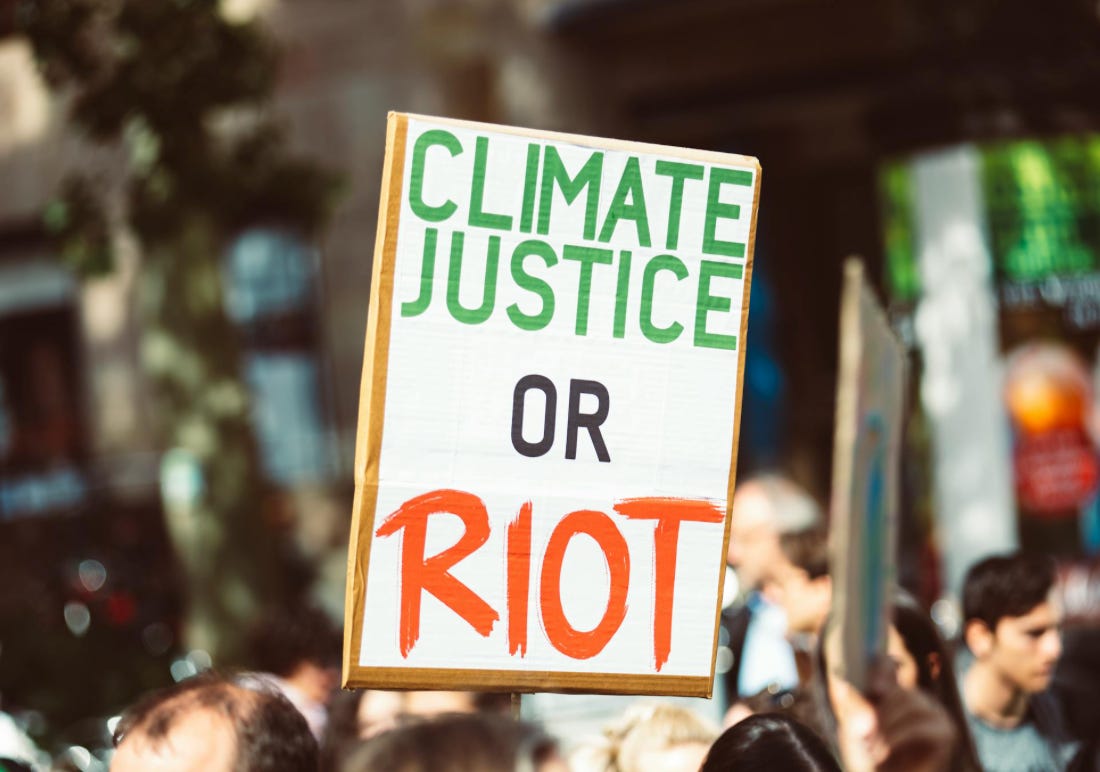
Photos by Markus Spiske, Pexels.com.
While climate change and environmental demonstrators and Antifa (short for “anti-fascist”) may both engage in protest or direct action, they differ fundamentally in motivation, structure, goals, and typical methods. Here’s a breakdown of those differences:
🌎 1. Core Focus and Goals
Environmental Demonstrators / Climate Activists
Aim: To protect ecosystems, reduce carbon emissions, prevent environmental degradation, and advocate for sustainable policy.
Motivation: Concern for planetary health, intergenerational justice, and biodiversity.
Typical movements: Extinction Rebellion, Fridays for Future, 350.org, Greenpeace.
Core message: “We must change our systems to live in balance with nature.”
Antifa
Aim: To oppose fascism, white supremacy, authoritarianism, and far-right extremism.
Motivation: Defense of marginalized communities and democratic freedoms against perceived fascist threats.
Core message: “We must stop fascism before it consolidates power.”
🧩 2. Organization and Identity
Environmental Demonstrators
Usually organized around identifiable groups with clear missions, leaders, or decentralized but transparent networks.
Often work with or pressure governments, NGOs, and international organizations.
Engage in permitted marches, symbolic acts, art installations, and peaceful civil disobedience.
Antifa
Not a centralized organization—more a loosely connected movement or ideology.
No official leadership or formal membership.
Local “Antifa” groups act independently, often underground or semi-anonymous.
🕊️ 3. Tactics and Methods
Environmental Demonstrators
Typically favor nonviolent protest, direct action (e.g., sit-ins, road blockades, tree-sits), and public awareness campaigns.
Some subgroups may use more disruptive tactics (like property obstruction), but their intent is generally to protect life, not harm.
Antifa
Range of tactics, from peaceful counter-protests to confrontational or militant direct action.
Some Antifa participants see property damage or physical confrontation with fascist groups as legitimate “self-defense.”
Their actions often occur in response to far-right rallies or extremist threats, not environmental policy.
⚖️ 4. Public Perception and Framing
Environmental Movements
Widely viewed as morally legitimate and tied to global humanitarian concerns.
May be criticized for disruption (e.g., blocking roads or airports), but rarely seen as violent.
Antifa
Highly polarized perception—some see them as protectors against fascism; others view them as anarchist or violent agitators.
Frequently targeted in political rhetoric and law enforcement scrutiny due to confrontational tactics.
🧠 5. Philosophical Foundation
Environmental Demonstrators
Draw on ecological psychology, systems thinking, and moral responsibility toward the Earth.
Core principle: Regeneration and preservation.
Antifa
Rooted in anti-fascist ideology that emerged from 20th-century resistance to Nazi and authoritarian regimes.
Core principle: Defense through opposition — stopping fascism “by any means necessary.”
Parallels
We can think of antifa’s core purpose—resisting domination and preserving diversity—as having deep ecological parallels in how natural systems maintain balance, resilience, and renewal. Here’s how that looks when related to non-violent protest and nature’s patterns:
1. Resistance to Domination — Forest Canopy Dynamics
In an old-growth forest, no single tree dominates indefinitely.
When one species or tree tries to monopolize sunlight or nutrients, others adapt—some grow in shade, others evolve symbiotic relationships, and fungi redistribute nutrients underground through mycorrhizal networks.
Parallel to Antifa:
Antifa movements resist the “monoculture” of fascism—the idea that one group, race, or ideology should rule over others.
Like a forest’s diverse species, human societies thrive when many perspectives coexist and nourish one another.
Non-violent activity:
Go to a forest or grove. Observe how diversity maintains harmony—no tree is supreme. Reflect on how societies might emulate this balance through inclusion and mutual support.
2. Collective Defense — Flocking Birds or Schooling Fish
When a predator attacks, a flock or school moves as one body, confusing the aggressor.
No central leader gives the order; the movement emerges from mutual awareness and coordination.
Parallel to Antifa:
Antifa networks act in decentralized solidarity—autonomous but attuned to one another, moving quickly to defend vulnerable communities.
This “leaderless” model mirrors nature’s self-organizing intelligence.
Non-violent activity:
Watch a murmuration of starlings or a school of fish. Notice how cooperation without command creates resilience. Consider how human movements can embody fluid unity while maintaining individuality.
3. Non-Violent Resistance — River Flow
A river resists obstacles not by attacking, but by flowing around them, wearing them down through persistence.
Its patience shapes valleys and landscapes over time.
Parallel to Antifa:
Many antifa-inspired activists and allied movements (like community educators and peace demonstrators) resist oppression through persistent non-cooperation—disrupting systems of harm without replicating their aggression.
Their “erosion” of fascist ideology happens through truth-telling, community building, and visibility.
Non-violent activity:
Sit beside a stream or river. Observe how the current shapes stone through gentle insistence. Ask: How can I embody this kind of endurance in the face of injustice?
4. Mutual Aid — Mycorrhizal Networks
Underground fungal networks connect trees, allowing them to share nutrients and warn each other of threats.
These systems sustain the health of the entire forest.
Parallel to Antifa:
Antifa groups often organize mutual aid—supporting communities with food, medical supplies, or protection from harm.
This mirrors how life sustains life in natural networks: no one thrives alone.
Non-violent activity:
Find a patch of forest soil. Reflect on the hidden cooperation beneath your feet. Imagine what “mutual nourishment” looks like in human communities under stress.
5. Renewal After Disruption — Fire Ecology
Some forests need periodic fire to release seeds, clear decay, and renew growth.
But the renewal depends on proportion—too much fire destroys, too little stagnates.
Parallel to Antifa and Protest:
Movements for justice often burn away the “underbrush” of complacency.
But mature non-violent movements learn how to transform outrage into renewal rather than destruction.
Non-violent activity:
Visit a recently burned or regrown area. Observe how life returns. Reflect on how protest can be cleansing and creative, not merely reactive.
🌎 In Summary:
Key Lesson: Forest canopy balanceResistance to dominationDiversity prevents tyrannyFlock movementDecentralized coordinationUnity through awarenessRiver flowNon-violent persistenceGentleness can transform stoneMycorrhizal networkMutual aidInterdependence strengthens communitiesFire ecologyProtest and renewalEnergy must be balanced and regenerative.
Experiencing Non-Violent Resistance as Nature Does
A five-part field practice for discovering how ecosystems model Antifa’s core values: diversity, defense, persistence, mutual aid, and renewal.
1. Forest Canopy – Diversity as Defense Against Domination
Theme: Balance through variety
Setting: A forest, grove, or any area with several tree species
Practice:
Walk slowly beneath the canopy and notice differences among trees—shapes, leaf textures, bark tones.
Sit where sunlight filters through leaves. Watch how light moves from one plant to another.
Reflect:
Which trees take more space, and which quietly adapt?
How do they coexist?
Write or speak this prompt:
“What might balance look like in human society if we valued diversity the way this forest does?”
Trustable truth to discover: Diversity prevents tyranny. Balance protects all.
2. Murmuration – Collective Defense Without Central Control
Theme: Unity through awareness
Setting: Open field, lake, or urban sky where birds gather (even pigeons or starlings)
Practice:
Observe a group of birds or insects moving together.
Notice the responsiveness—how one’s motion ripples through the group.
Without speaking, mimic this with friends or alone by mirroring wind or leaf movement.
Reflect:
“How can humans coordinate fluidly, defending one another without command or domination?”
Trustable truth to discover: Awareness links us. True defense is relational, not hierarchical.
3. River Flow – The Power of Non-Violent Persistence
Theme: Steadfastness without aggression
Setting: Stream, riverbank, or even a roadside drainage channel after rain
Practice:
Watch water meeting rocks. Notice how it bends, persists, and eventually shapes them.
Place a small stick or leaf in the current. Follow its journey downstream.
Reflect:
“Where in my life can gentleness wear down cruelty?”
“How can steady motion transform what force cannot?”
Trustable truth to discover: Non-violence isn’t weakness; it’s endurance made visible.
4. Mycorrhizal Network – Mutual Aid Beneath the Surface
Theme: Interconnection and shared support
Setting: Forest floor, garden bed, or soil-rich area
Practice:
Gently brush away fallen leaves; look for mycelium threads or worm trails.
Imagine the exchange happening beneath—nutrients, messages, life’s quiet generosity.
If others are present, form a circle and share one resource or supportive gesture (a snack, water, kind word).
Reflect:
“What hidden networks sustain me?”
“How can I nourish others in return?”
Trustable truth to discover: Support unseen is still powerful. Connection is protection.
5. Fire Ecology – Renewal Through Controlled Transformation
Theme: Regenerative energy
Setting: A field recovering from fire, or an area where decay feeds new life (compost, fallen logs, autumn leaves)
Practice:
Observe what has returned after disturbance—seedlings, moss, insects.
Collect one small natural symbol of renewal (charred twig, sprouting shoot).
Reflect:
“What inner fires can I channel into creative renewal?”
“What must be released for life to flourish again?”
Trustable truth to discover: Transformation, when guided by care, renews rather than destroys.
Closing Integration – Becoming Part of Nature’s Non-Violent Resistance
Find a quiet place outdoors. Review your observations and insights. Ask yourself:
What lessons from these ecosystems apply to resisting oppression humanely?
How can I embody these patterns—flow, awareness, balance, connection, renewal—in daily life and activism?
Then, express gratitude to the natural world for its living instruction.
HumaNatureConnect Activity
Experiencing Non-Violent Resistance as Nature Does
A guided field immersion for eartHearts and other circles preparing for ecological or social action.
Purpose
To help participants feel and embody the ways nature models non-violent resistance—through diversity, awareness, persistence, mutual aid, and renewal.
The activity cultivates inner and group alignment before engaging in public activism or environmental service.
Overview
ElementThemeDuration1. Forest CanopyDiversity as Defense Against Domination25 min2. MurmurationCollective Defense Without Central Control20 min3. River FlowNon-Violent Persistence25 min4. Mycorrhizal NetworkMutual Aid Beneath the Surface20 min5. Fire EcologyRenewal Through Controlled Transformation30 minClosing CircleIntegration and Gratitude15 minTotal: ~2½ hours (can be shortened or spread over multiple sessions)
1. Forest Canopy – Diversity as Defense Against Domination
Theme: Balance through variety
Setting: Forest, park, or grove with different plant species
Materials: Journals, pens, optional hand lenses
Facilitator Steps:
Invite the group to walk silently among the trees, noticing variations in height, shape, and color.
Gather in a circle under mixed canopy.
Ask:
“How does this forest share space?”
“What prevents one species from taking over?”
Read aloud:
“Diversity is the forest’s defense against domination.”
Reflection Prompt:
“What social or inner diversity do I need to honor so that balance is preserved?”
Group Sharing: 5 minutes of voluntary insights.
2. Murmuration – Collective Defense Without Central Control
Theme: Unity through awareness
Setting: Open area where birds or insects move freely
Materials: None
Facilitator Steps:
Have participants observe group flight or swarm patterns.
Ask them to silently mimic the movement of leaves or the breeze together—staying attuned, without speaking.
Gather for discussion.
Debrief Questions:
“How did you know when to move?”
“What was the source of your coordination?”
Facilitator Note: Emphasize that non-violent coordination relies on trust and attentiveness, not domination.
3. River Flow – The Power of Non-Violent Persistence
Theme: Steadfastness without aggression
Setting: Riverbank, creek, or any flowing water
Materials: Small biodegradable markers (sticks or leaves)
Facilitator Steps:
Invite each participant to place their stick in the flow, following it visually.
Encourage them to notice the river’s flexibility and persistence.
After 10 minutes, gather and ask:
“What obstacles did you see the river face?”
“How did it respond?”
Reflection Prompt:
“Where in my life can gentle persistence transform what force cannot?”
4. Mycorrhizal Network – Mutual Aid Beneath the Surface
Theme: Interconnection and shared support
Setting: Area with rich soil or decomposing leaves
Materials: Magnifying lenses, small digging sticks (optional)
Facilitator Steps:
Have participants observe soil layers, roots, or fungal threads.
Invite them to share a small gesture of mutual aid—a kind word, water, snack, or supportive touch.
Circle together and discuss:
“What unseen networks sustain you?”
“How might our group act as an underground support system?”
Facilitator Note: Emphasize that strength grows from invisible cooperation, not visible dominance.
5. Fire Ecology – Renewal Through Controlled Transformation
Theme: Regenerative energy
Setting: Field or forest area showing regeneration, or any site of natural decay and new growth
Materials: Charcoal sticks, small paper slips
Facilitator Steps:
Ask participants to find a natural symbol of renewal (e.g., seedling, sprout, decomposing log).
On a slip of paper, write what they wish to release (anger, fear, apathy).
Rub charcoal lightly on the paper as a mark of transformation.
Bury or compost it as an offering to renewal.
Debrief Questions:
“What needs to burn away for new growth in my activism?”
“How does nature teach restraint in renewal?”
Closing Circle – Integration and Gratitude
Setting: Quiet spot outdoors
Facilitator Steps:
Invite everyone to share one “trustable truth” discovered today.
End with collective gratitude—spoken or silent—for the living world as teacher.
Optional chant or affirmation:
“We learn resistance from the forest, renewal from the flame, and peace from the flow.”
Facilitator Guidance
Keep transitions slow and mindful—let each stage breathe.
Encourage embodied noticing over abstract talking.
Maintain a tone of reverence, not debate.
Close with stillness so participants carry calm resilience back into daily life and activism.
Essential Readings:
• […]
• […]

Recommended Readings:
• […]
• […]
• […]
• […]

For additional readings, visit Heartwood Path Beat.